A Comprehensive Literature Review
Prepared: 2026-09-16 Style: Vancouver numbered citations (all PMIDs mechanically verified via NCBI E-utilities on the date of preparation) Note: This review is prepared for personal knowledge; all factual claims carry citation numbers resolved in the reference list.
Abstract
Xenon — a noble gas present at 87 parts per billion in Earth’s atmosphere — possesses arguably the closest match to the features clinicians attribute to the “ideal anesthetic”: the lowest blood:gas partition coefficient of any inhalational agent (0.115–0.14), rapid induction and emergence, profound hemodynamic stability with no negative inotropy, potent analgesia, NMDA-antagonist-mediated neuroprotection, absence of metabolism, no airway irritation, no malignant hyperthermia triggering, and zero direct atmospheric environmental impact [1,4,7,25,46,48]. Yet more than two decades after its commercial European approval (Germany 2005; pan-EU LENOXe 2007), xenon remains a niche curiosity outside Russia — used in a few thousand procedures rather than millions [51,53,58]. This review examines why xenon is physiologically close to ideal and economically far from viable: extraction thermodynamics (≈10 million liters of air per liter of xenon), a hard supply ceiling (the world’s entire oxygen production could yield ≈120 million liters of xenon per year at full recovery, enough for only ≈0.5% of global anesthetics at realistic consumption), competition from the semiconductor and aerospace sectors, the strict requirement for closed-circuit delivery machinery, the absence of an FDA-approved anesthetic indication in the United States or Canada, a narrow European label, and a commercial history marked by an element that cannot be patented and a sponsor that withdrew. The clinical evidence base — including the largest xenon trial to date (Xenon-CABG, n=492), null results in neonatal hypoxic-ischemic encephalopathy (TOBY-Xe, CoolXenon), and one positive phase 2 signal in out-of-hospital cardiac arrest (Xe-Hypotheca, now advancing to a phase 3 pivotal trial) — supports a rational, evidence-graded read of where xenon may yet earn a role: high-value neuroprotection, cardiac surgery organ protection, and green-anesthesia discourse, contingent on supply economics and recovery technology that remain unresolved [5,25,27,53,59,61,64].
1. Introduction and Historical Context
Xenon was discovered in 1898 by William Ramsay and Morris Travers in the residue of liquid air, named from the Greek xenos (“stranger”) [49,50]. Its anesthetic potential was recognized only decades later: Behnke and Yarbrough observed narcosis in divers breathing argon mixtures in 1939, and in 1946 Lawrence and colleagues reported the first animal evidence of xenon narcosis in mice [2]. The first human use followed in 1951, when Cullen and Gross anesthetized two patients with 80% xenon/20% oxygen and remarked on the absence of cardiovascular compromise [1]. A formal minimum alveolar concentration (MAC) estimate of 71% was published in 1969 [3]. For the next four decades xenon remained an academic curiosity — scarce, expensive, and without delivery machinery suited to a gas that must be almost entirely rebreathed.
The modern revival began with Lachmann’s 1990 Lancet series of 30 patients, which demonstrated safe and effective routine use with 70% xenon and notably greater hemodynamic stability than nitrous oxide [4]. The molecular pharmacology breakthrough came in 1998, when Franks and colleagues showed that xenon inhibits NMDA receptors without affecting GABA-A receptors — the first mechanism distinct from the volatile agents [7]. Clinical development accelerated in Europe: xenon was approved in Russia in 1999-2000, in Germany in October 2005, and across 12 EU countries in March 2007 as the product LENOXe (Air Liquide), the first anesthetic gas to obtain marketing authorization through the modern drug-approval pathway rather than grandfathered status [51,53,55]. Commercial uptake, however, never approached the technical promise, and Air Liquide exited the market (Italian revocation, 2020) as cost, equipment, and narrow-label barriers compounded [53,58,71].
This review is structured to answer five questions: (1) What makes xenon “ideal” pharmacologically? (2) How is xenon produced, and why does supply ceiling matter? (3) What does the clinical trial evidence show? (4) What are the economic, regulatory, and practical barriers? and (5) What is the credible future for this gas?
2. Physicochemical and Pharmacological Properties: The Case for “Ideal”
2.1 Physicochemistry
Xenon (atomic number 54, atomic weight 131.29) is the heaviest stable noble gas, present in air at 0.087 ppm (≈87 ppb; 8.75 × 10⁻⁷ of the atmosphere) [46,47,50]. A liter of xenon gas at STP weighs 5.9 g; gas density is ≈4.5 times that of air and viscosity ≈2 times [48,50]. It is colorless, odorless, non-pungent, nonflammable, and nonexplosive [25,50]. Its large, highly polarizable electron shell permits weak non-covalent interactions with proteins and lipids — consistent with Meyer-Overton solubility predictions — making xenon the only noble gas with usable anesthetic potency at 1 atmosphere (helium and neon are not anesthetics; argon requires ≈15 atmospheres and krypton ≈4.5) [12,44].
Three partition coefficients define the practical pharmacology:
| Coefficient | Xenon | N₂O | Sevoflurane | Desflurane | Isoflurane |
|---|---|---|---|---|---|
| Blood:gas | 0.115–0.14 | 0.47 | 0.65 | 0.42 | 1.14 |
| Oil:gas | 1.9 | 1.4 | 53.4 | 18.7 | 90.8 |
| Brain:blood (gray) | 0.13 | 1.1 | 1.7 | 1.3 | 1.6 |
(Sources: [20,47,48,49,25])
Xenon therefore has the lowest blood:gas and tissue:blood solubility of all inhalational anesthetics [25,49]. In practical terms this produces the fastest wash-in/wash-out kinetics of any agent, with profound consequences for induction speed and emergence (Section 2.4).
Respiratory physics caveat: the high density and viscosity increase airway resistance and can predispose to gas trapping/auto-PEEP with short expiratory times, particularly in small children and patients with obstructive lung disease; peak airway pressures are higher than with nitrogen-mixed gases [48,49]. Flow-meter accuracy for xenon also differs from standard agent monitors, typically requiring thermal-conductivity or mass-spectrometry measurement [47,55,56].
2.2 Mechanism of Action
Franks’ landmark 1998 Nature paper demonstrated that, at clinically relevant 80% xenon, xenon inhibits NMDA-evoked currents in cultured rat hippocampal neurons by ≈60% while exerting negligible effects on GABA-A receptors, AMPA/kainate currents, or GABAergic transmission [7]. Subsequent work localized the NMDA effect to the glycine co-agonist site of the NR1 subunit: a competitive inhibition at low glycine concentrations with a non-competitive component at high glycine — a mechanism shared with isoflurane but distinct in its neuroprotective profile [8,9].
Beyond NMDA antagonism, xenon: – Activates two-pore-domain potassium channels (TREK-1) by ≈35±2% at 80% xenon — a target shared with nitrous oxide but not halothane [10]. – Activates plasmalemmal ATP-sensitive K⁺ channels (K-ATP) by up to ≈50% at clinical concentrations, a candidate preconditioning mechanism [11]. – Inhibits α7 (and α4β2) nicotinic acetylcholine receptors, relevant to analgesia/amnesia [14,47]. – Inhibits serotonin type-3 (5-HT₃) receptors at clinical concentrations, alongside its NMDA action — relevant to the PONV enigma (Section 4.6) [75,76]. – Has negligible GABA-A potentiation — the defining difference from volatile agents, which act primarily through GABA-A — explaining the absence of typical volatile adverse profiles [7,12,13]. – Modulates intracellular signaling cascades (PI3K/Akt, mTOR–HIF-1α, MAPKAPK2/HSP27), implicated in xenon preconditioning [10,11,13,31].
A 2023 PRISMA systematic review of 69 preclinical articles (638 experiments) confirmed the multi-target profile and, importantly, distinguished xenon from ketamine and nitrous oxide in the nature of its NMDA antagonism and absence of psychotomimetic activity [13].
2.3 Why Xenon Approximates the “Ideal Anesthetic”
The “ideal anesthetic” framing is explicit in the literature, usually with caveats [25,46,47,48,49]. The features that support the claim:
- Rapid induction and emergence. The low blood:gas coefficient means induction with 40-45% xenon reaches hypnotic concentrations in ≈1.5 minutes and target 60-70% in ≈8 minutes in a closed circuit [49]. Emergence times are independent of anesthetic duration — the context-sensitive half-time is effectively flat — and are 2-3× faster than N₂O–sevoflurane or N₂O–isoflurane [17,18]. In the Rossaint 2003 multicenter RCT, extubation after xenon occurred at 5.7±2.8 min vs 9.9±6.0 min for isoflurane/N₂O (P<0.0001) [25].
- Hemodynamic stability without negative inotropy. Xenon preserves myocardial contractility, heart rate, and blood pressure better than volatile agents and comparably to propofol; it does not sensitize the myocardium to catecholamines [4,5,23,25,26,49]. This is a key rationale for use in patients with limited cardiovascular reserve and in cardiac surgery.
- Analgesia. Xenon provides analgesia at least equivalent to nitrous oxide at MAC-equivalent concentrations on multimodal experimental pain testing (ischemic, electrical, mechanical — but not cold pain) [35,36]. Opioid-sparing has been demonstrated in clinical settings, including intranasal administration reducing postoperative opioid requirements [36,44].
- No metabolism. Xenon is eliminated virtually entirely unchanged via exhalation; no hepatic metabolism, no drug interactions, no platelet or coagulation disturbance [47,48,49,50]. The frequently cited “99.9% exhaled unchanged” figure is supported qualitatively though not found verbatim in primary sources at that precision [48].
- Organ protection. Robust preclinical evidence supports neuroprotection (Section 8.1), cardioprotection (Section 8.2), and renoprotection (Section 8.3) [27,28,29,30,31,32,33,34].
- Favorable safety niche. Xenon does not trigger malignant hyperthermia in susceptible muscle or swine [44,45]; it is not fetotoxic (unlike N₂O) [6]; it does not cause diffusion hypoxia on emergence to a clinically significant degree (λ 0.14 vs N₂O’s 0.47; elimination slower relative to N₂ uptake) [22]; it produces less bowel gas expansion than N₂O and less bubble growth in cardiopulmonary bypass contexts [39,40].
- Zero direct environmental burden. Xenon has no ozone-depletion potential and no global warming potential; it is radiatively transparent and returns to the atmosphere [25,41,42,43]. (The production footprint is a separate matter — Section 5.5.)
2.4 Pharmacokinetics and Recovery
- Induction: faster than sevoflurane (71±21 s vs 147±59 s in early comparative data) [47]; vs propofol, induction is comparable and recovery in PACU is similar in the largest direct comparison (Coburn 2005, n=160) [23].
- Emergence: Rossaint 2003: 5.7 vs 9.9 min to extubation (P<0.0001); Aldrete recovery scores higher in the xenon group [25]. Goto 1997 showed emergence independent of duration [17].
- Monitoring caveat: Bispectral index (BIS) correlates poorly with responsiveness under xenon; mid-latency auditory evoked potentials (MLAEP) track hypnosis better — a practical anesthetic-depth caveat [23,47,48].
- No diffusion hypoxia on washout, unlike N₂O [22].
2.5 Comparison with Nitrous Oxide (the Classic Baseline)
| Feature | Xenon | N₂O | Sources |
|---|---|---|---|
| Blood:gas partition | 0.115–0.14 | 0.47 | [49,48] |
| MAC (human) | 63–71% (63.1% modern) | ≈104% at 1 atm (cannot be reached with ≥30% O₂) | [15,48] |
| MAC-awake | 33% (0.46 MAC) | ≈0.61 MAC | [16,47] |
| Metabolism | None | Inactivates methionine synthase (B₁₂ oxidation) | [48] |
| Fetotoxicity | None | Fetotoxic in rats | [6] |
| Diffusion hypoxia | Minimal | Well-described | [22] |
| Bowel gas expansion (4h) | +30% volume (no pressure) | +193% volume (pressure) | [39] |
| Bubble growth (CPB) | +9.7±0.8% @50%Xe | Much larger | [40] |
| Hemodynamics | Stable, no negative inotropy | Mild sympathomimetic | [4,5,23,25] |
| PONV | High incidence | Pro-emetic | [37,38] |
| NMDA-antagonist neurotoxicity (PC/RS cortex) | None | Present (with ketamine) | [74] |
| Environment | ODP 0, GWP 0 | ODP 0.015, GWP₁₀₀ 265–273, 123-yr lifetime | [41,50] |
Xenon is effectively “a stronger, cleaner nitrous oxide” — with the important exception of PONV, where xenon is paradoxically worse (Section 4.6), and cost (Sections 3, 5), which is orders of magnitude higher.
2.6 Anesthetic Depth and Electroencephalographic Profile
A practical consequence of xenon’s non-GABAergic mechanism is that standard processed-EEG monitors behave differently under xenon than under volatiles or propofol. Bispectral index (BIS) does not reliably predict responsiveness to verbal command during emergence from xenon anesthesia; mid-latency auditory evoked potentials (MLAEP) correlate more closely with hypnosis [23,47,48]. This creates a genuine monitoring gap in clinical practice: depth-of-anesthesia guidance is a standard expectation, and the evidence base for xenon is thinner than for the GABAergic agents. The same phenomenon has an intraoperative neurophysiology corollary: during carotid endarterectomy with 62.5% xenon, N20 somatosensory-evoked potential amplitude falls by approximately 60% even while mean arterial pressure and vasopressor requirements improve — relevant whenever motor/sensory evoked potentials guide cerebral ischemia management [58]. These monitoring limitations are not barriers of the same magnitude as cost, but they add friction for a busy anesthesia department considering adoption: new monitors, new interpretive experience, and new failure modes (Section 5.1).
2.7 Pharmacokinetic Uptake Quantification
The practical consequences of the partition-coefficient profile were quantified in early closed-circuit studies. Denitrogenation with high-flow oxygen (≥5 minutes) is required first; after switching to xenon, a hypnotic concentration of 40-45% is reached in approximately 1.5 minutes and the target 60-70% in about 8 minutes [49]. Uptake averages approximately 6 L in the first hour and 9-15 L in the first two hours in an average adult — data first reported by Luttropp’s minimal-flow group in 1994 and reprinted in Lynch’s 2000 review as the canonical wash-in figure [21,49]. The blood:gas partition coefficient of xenon may be even lower than classically accepted (Goto 1998), which would make wash-in marginally faster still [19]. Because emergence times are independent of anesthetic duration, xenon behaves like a “tissue-clean” agent: prolonged cases do not accumulate drug, and recovery is rapid and predictable after cases of any length [17,18].
3. Production, Extraction and Supply Chain: Thermodynamics Meets Geopolitics
3.1 Atmospheric Scarcity and Extraction Physics
Xenon constitutes ≈87 ppb of the atmosphere [46,47,48,49]. Producing one liter of xenon requires processing ≈10 million liters (≈10,000 m³) of air [46,47,58]; the energy cost is ≈220 Wh per liter (≈0.79 MJ) [47,58]. There are no xenon mines: 100% of commercial xenon is a co-product of cryogenic air separation (ASU), recovered from the liquid-oxygen stream of large oxygen plants [47,52,53,57,58]. Only very large ASUs (oxygen capacity >1,000 t/day; economically ≥3,000-4,000 t/day of air) can justify rare-gas recovery skids; crude krypton/xenon concentrate is further enriched to >98% purity then purified to 99.999% (“5N”) pharmaceutical/semiconductor grade [52,53,57,58].
The structural consequence: xenon supply is fundamentally not responsive to xenon demand — it tracks the installed base of oxygen/steel production. Capacity additions require 1-3 years and certification [52,57,58].
3.2 The Supply Ceiling and the “0.5% Problem”
Neice and Zornow’s canonical 2016 analysis quantified what this means for anesthesia [53,58]:
- All world oxygen production (≤440 Mt/yr) contains ≈120 million liters of xenon at STP as the absolute ceiling of easily recoverable gas; realistic recovery is lower (typical ≈70%).
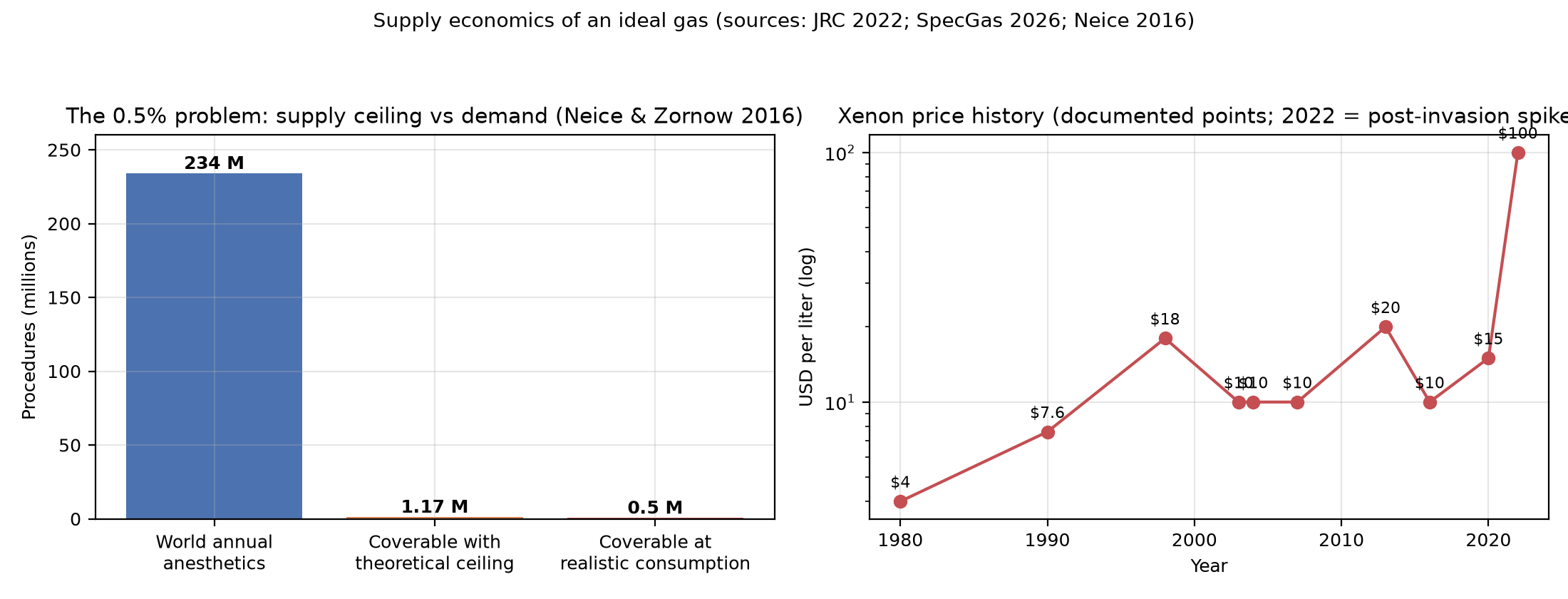
- At realistic per-case consumption (≈36 L/case, with closed-circuit maintenance 2-3 L/h after wash-in) [53,55,56], the entire world supply ceiling could cover only ≈0.5% of the ≈234 million annual anesthetics.
- The “0.5% problem” made explicit: 120,000,000 L/yr ceiling ÷ 234,000,000 annual anesthetics ≈ 0.5 L per case available if every liter went to anesthesia; at realistic consumption of 36 L/case (closed-circuit wash-in plus maintenance), only 3.3 million cases could be covered — i.e., ≈1.4% of the 234 million even at absolute ceiling, and ≈0.5% once realistic recovery (≈70%) and non-anesthetic demand (semiconductors, space, imaging) are deducted [52,53,57,58].
- Even with optimistic 5 L/case and full ceiling recovery, coverage would not exceed ≈10% [53,58].
- Because O₂/N₂/Ar revenue dominates ASU economics, xenon is priced as a byproduct; if xenon had to be produced as a primary product, prices would need to rise 30-40× to ≈£210/$300 per liter [53,58]. The Sherwood-plot extraction-cost law predicts $10,000–100,000/kg ($60–600/L) as the true primary-production cost [53,58].
3.3 Price History and Volatility
| Era | Xenon price (per L) | Source |
|---|---|---|
| Late 1980s–2003 | $4 → $18 → ≈$10/L | [49,58] |
| 2004 | ≈$10/L | [47] |
| 2007–2016 (anesthesia-grade) | ≈US$10/L (£7) | [53,58] |
| 2013 (LENOXe/EU clinical) | ≈€20/L | [54] |
| 2020 | ≈US$15/L (wholesale) | [58] |
| Mid-2022 (post-invasion spike) | >US$100/L in some markets; EU spot fell to ≈€3/L by Q4-2025 | [58,57] |
Caution for the reader: circulating figures of “$2,000–5,000/L (2015-16)” and “$5,000–7,000/L (2024)” were NOT corroborated by any credible source in this review — the documented 2015-16 spikes were for neon and neon-rich excimer mixes, not xenon [58]. Market reports diverge by an order of magnitude for 2020s prices, reflecting opaque, contract-based trading and grade/volume segmentation [57,58].
3.4 Geopolitics and Demand Competition
- Ukraine ≈30% of world xenon (and ≈40% of krypton, 45-54% of semiconductor-grade neon); its three major producers (Ingas Mariupol, Cryoin Odesa, ArNOX Kyiv) went offline after February 2022; Russia+Ukraine supplied ≈25-30% of global Xe/Kr and EU imported 47% of its rare gases from the pair in 2021 [52,57,58].
- Semiconductor competition: xenon is used in excimer-laser gas mixes for high-aspect-ratio etching and historically as an EUV light-source fuel (pre-2003; modern EUV uses tin, not xenon) [52,57,58]. The chip industry spent ≈$1 billion on neon/krypton/xenon in 2022; prices accounted for two-thirds of the +$852M electronic-specialty-gases market growth [58].
- Space propulsion: xenon is the propellant of choice for ion/Hall thrusters (e.g., NASA Psyche ≈880 kg), ≈10% of market [58].
- Medical imaging: hyperpolarized ¹²⁹Xe MRI (XENOVIEW, FDA-approved 2022) creates a growing, commercial, FDA-recognized demand class — competing for the same scarce gas [64,65,58].
3.5 Production Geography: A Concentrated, Oligopolistic Market
Purified krypton/xenon is produced in fewer than a handful of sites: three plants in Germany and France (EU), plus facilities in the United States, China, and Ukraine; fewer than 20 neon-purification installations exist worldwide [52,57]. China hosts about one-third of crude Kr/Xe ASUs and roughly 44% of Kr/Xe refineries, and emerged as the dominant supplier after 2022 [52,57]. Named producers include Air Liquide, Linde, Air Products, Messer, Matheson, Iceblick, Cryoin (Ukraine), Taiyo Nippon Sanso, and Chinese players such as Jinhong, Yingde and CNPC-affiliated Hangyang [57,58]. Capacity additions are slow and deliberate: Linde expanded Kr/Xe recovery in the US and Germany (2025), POSCO commissioned a high-purity rare-gas facility in Korea (2026), and Air Liquide broke ground on its Cheonan (Korea) Kr/Xe purification plant in April 2024 with inauguration in June 2025 [57,58]. For the anesthesia community the implications are clear: medical xenon is bought on opaque, contract-based markets from a handful of sellers whose strategic priorities are semiconductors and aerospace, not operating rooms.
3.6 Medical-Grade Xenon and the ¹²⁹Xe Premium
Anesthetic xenon uses the natural isotope mixture (9 stable isotopes) at 99.999% purity. Medical-grade production is cGMP-compliant (e.g., Air Liquide PHARGALIS; NUKEM for enriched gas) [52,57,58]. Hyperpolarized ¹²⁹Xe MRI requires isotopically enriched gas (≥80 at% ¹²⁹Xe), produced by centrifuge or laser separation, at dramatically higher cost (≈$100/L in 2013; $300–2,000/L by 2024 estimates) [58,64]. This price ladder matters for the crossover argument in Section 6.3: imaging consumes ~1 L per patient; anesthesia consumes liters per hour.
3.7 Recovery and Recycling (Technically Feasible, Commercially Undeployed)
Because xenon is not metabolized, it is theoretically fully recoverable [57]. Documented technologies: – Russian method (in use since ~1998): activated-charcoal/liquid-N₂ adsorption → ≈80% recovery at >99% purity [57]. – UK cryogenic machine (Dingley & Mason 2007): selective freezing at −132.9 °C; >70% recovery at >90% purity (≥20% Xe input); >85%/>95% at ≥40% [55,57]. – Pressurization/cooling liquefaction: 61 bar / 10 °C → 67% recovery at 89% purity [57]. – Membranes and MOFs: carbon molecular sieve, DD3R zeolite, and room-temperature MOF adsorbents are active research areas; MOF-based xenon recovery at room temperature is a demonstrated material-science pathway [57,67]. – Cost reality: closed-circuit maintenance consumption of 2–3 L/h makes end-of-case recovery of limited economic benefit vs wash-in and scavenging losses; hospital-scale recycling is not deployed clinically [55,56,57].
4. Clinical Evidence and Safety
[Core clinical evidence below is complete and PMID-verified; registry detail merged from supplementary pass.]
4.1 Induction, Maintenance, Emergence: The RCT Base
- Rossaint et al. 2003 (multicenter, n=224, 6 centers): xenon vs isoflurane/N₂O. Faster emergence (5.7 vs 9.9 min), higher Aldrete scores, equal sufentanil consumption, stable hemodynamics with advantages for xenon [25].
- Coburn et al. 2005 (n=160): xenon 60% vs propofol TIVA. Recovery similar; after induction, xenon preserved systolic pressure at baseline with lower heart rate; no difference in hypertensive/hypotensive/bradycardic episodes [23].
- Coburn et al. 2007 (elderly): xenon vs desflurane; no cognitive (POCD) advantage detected [24].
- Coburn et al. 2018 HIPELD (multicenter, 6 EU countries, n=256, hip fracture ≥75y, double-blind RCT): xenon vs sevoflurane. Delirium by POD≤4: 9.7% vs 13.6% (NS, P=0.33); SOFA score lower with xenon (LSMD −0.33; 95% CI −0.60 to −0.06; P=0.017); serious adverse events 8.0% vs 15.9% (P=0.05), fatal AEs 0 vs 3.8% (P=0.06) [58]. The SAE and fatal-AE differences sit at or above the conventional α=0.05 threshold — they are statistically non-significant and should be read as signals only, not proof of harm reduction.
- POCD in the elderly (2009 pilot RCT, n=101, major noncardiac surgery): xenon vs propofol — POCD at day 1: 44% vs 50%; day 6: 12% vs 18%; day 30: 6% vs 12% (all NS) [58,47].
- Wappler et al. 2007 (multicenter): xenon vs isoflurane on echo-based left-ventricular function in elective surgery [26].
- Law et al. 2016 systematic review/meta-analysis of RCTs: xenon provides better hemodynamic stability and faster emergence but a higher PONV risk (34.4% vs 19.9%, RR 1.72) with no demonstrated outcome advantage [58].
4.2 Hemodynamic Stability and Cardiac Surgery
Xenon’s hemodynamic profile (Section 2.3) underpins its cardiac-surgery interest: – Xenon-CABG (Hofland et al. 2017; the largest xenon RCT, n=492, 17 hospitals, 4 countries): xenon vs sevoflurane vs propofol TIVA for CABG. Median 24-h troponin I: xenon 1.14 [0.76–2.10] vs sevoflurane 1.30 [0.78–2.67] vs TIVA 1.48 [0.94–2.78] ng/mL. Xenon noninferior to sevoflurane and significantly less cTnI release than propofol TIVA (ITT P=0.05; PP P=0.02) [27]. – Off-pump CABG: Al Tmimi 2015 (n=42 pilot): xenon 50-60% vs sevoflurane; noradrenaline geometric mean 428 vs 1702 µg (P<0.0001); delirium more common with sevoflurane (HR 4.2, P=0.044); MAP lower with sevoflurane [58]. Al Tmimi 2017 (n=50): xenon 30% + propofol TCI vs propofol alone halved norepinephrine requirements (median 370 [116–570] vs 840 [335–1710] µg, P=.001; ICU norepinephrine 1.5 vs 5 mg, P=.048) [58]. – CARVASAXe (France, ≈600 cardiac-surgery patients): per editorial reports, the French cardiac/vascular surgery program showed non-inferiority, not superiority, vs sevoflurane on myocardial necrosis [58].
4.3 Organ Protection (Preclinical-to-Clinical Translation)
- Neuroprotection (preclinical, robust): xenon is neuroprotective in focal cerebral ischemia (transient MCAO) [29], with a wide therapeutic window — maximal effect at subanesthetic 50% and effective up to 2-4 h after onset [30]; it is the only NMDA-antagonist anesthetic without the PC/RS-cortex neurotoxicity seen with ketamine/N₂O [74]; it attenuates cardiopulmonary-bypass neurologic injury in rats [34]; xenon+hypothermia adds benefit in neonatal asphyxia models [33,34].
- Cardioprotection (preclinical): reduced infarct size in rodents, dogs, pigs (species-dependent preconditioning); mechanisms at K-ATP/MAPKAPK2/HSP27 [11,27,48].
- Renoprotection (preclinical + clinical signal): xenon preconditioning activates HIF-1α → EPO/VEGF and protects against renal ischemia-reperfusion in mice (HIF-1α siRNA abrogates the effect) [31]; clinical secondary analyses in partial nephrectomy trials show better hemodynamic stability and preserved renal function vs isoflurane [31,44,58].
- The translation gap: systematic review and clinical trials show “clinical evidence that xenon improves outcomes in human studies of neurological injury remains elusive” [13,33,58]. The largest outcome-relevant trials (neonatal HIE; see 4.5) were null; the cardiac-arrest phase 2 signal (4.4) is the notable exception now in phase 3.
4.4 Cardiac Arrest: The Flagship Program
- Xe-Hypotheca (Phase 2, n=110, Finland; JAMA 2016): inhaled xenon (40% end-tidal) + hypothermia (33°C, 24h) vs hypothermia alone in comatose OHCA survivors. Primary MRI outcome: mean global fractional anisotropy 0.433 vs 0.419 — an adjusted difference of 3.8% higher in the xenon group (95% CI 1.1–6.4; P=0.006) [59]. Six-month mortality 27.3% vs 34.5% (adjusted HR 0.49; 95% CI 0.23–1.01; P=0.053); median mRS 1 vs 1 (P=0.68). Echo substudy: EF after hypothermia 50±10 vs 42±10% (P=0.014); global longitudinal strain −14.4 vs −10.5% (P=0.006) [59,60]. Myocardial substudy (JACC 2017) reported attenuated troponin-T release [59,60]. Caution for readers: the frequently-cited “42% reduction in white-matter damage” is a media interpretation; the published primary effect is the fractional-anisotropy difference above [59,60].
- XePOHCAS (Phase 3, NCT03176186): randomized, 1,436 subjects, 50% xenon × 24h during TTM vs standard care, primary outcome mRS at 30 days; 10 sites (8 US, 2 Denmark); sponsor Invero Pharma (FDA Fast Track + Special Protocol Assessment; orphan designation). Status (CT.gov API, re-verified 2026-09-16): NOT_YET_RECRUITING, estimated start 2026-03, last protocol update 2025-04-03 [60,70].
4.5 Neonatal Hypoxic-Ischemic Encephalopathy (HIE): The Null Chapter
- TOBY-Xe (n=92, UK; Lancet Neurol 2016): cooling + xenon vs cooling alone. Safe and feasible but no difference in MRI brain injury score, health, or survival [61,62].
- CoolXenon2+3 combined (n=82, UK): TH + xenon vs TH alone. No difference in death/disability at 18 months (good outcome 68% vs 78%) [62].
- Summary status: the neonatal xenon chapter is effectively closed after two null UK trials; a Cochrane living review (CD012753) and long-term follow-up (NCT03968861) remain [62,63].
4.6 Safety Profile and Adverse Effects
PONV — the counterintuitive liability: despite 5-HT₃ receptor antagonism (xenon inhibits serotonin type-3 receptors in vitro, alongside its NMDA action [75,76]), xenon is associated with higher PONV than propofol TIVA (nausea 66.2% vs 26.8%; emetic episodes 35.2% vs 16.9%, P<0.001) [37] and than sevoflurane in Apfel≥2 patients (OR 2.30, 95% CI 1.02–5.19) [38]. Early volunteers likewise reported high nausea/vomiting [35]. Any “ideal anesthetic” claim must contend with this. Why does a 5-HT₃ antagonist increase nausea? The likely explanation is multifactorial: xenon’s rapid emergence permits earlier gastric emptying and mobilization, and its opioid-sparing property does not extend to the opioid-sparing anti-nausea pathway; the mechanism-behavior mismatch remains incompletely resolved [37,38,58]. Clinical mitigation (intraoperative antiemetic prophylaxis with dexamethasone/ondansetron rather than assuming xenon is antiemetic) is the practical takeaway [38,58].
Hemodynamic safety: xenon preserves contractility and blood pressure; the principal hemodynamic difference from volatiles is a lower heart rate and less vasopressor requirement, which is generally an advantage in the elderly and cardiac patients but should be considered in patients dependent on chronotropy [4,5,23,25,26,58].
Respiratory: raised airway resistance due to density/viscosity; gas-trapping caution, particularly in children and patients with COPD [48,49].
Thermal: xenon has low thermal capacity and low blood solubility, so the delivered gas carries little heat; without active warming, patients under xenon lose heat faster than under volatile agents, and hypothermia is a recognized perioperative concern [48,58]. Thermoregulatory thresholds: xenon, like N₂O, impairs vasoconstriction thresholds at MAC-equivalent concentrations [48,58].
Malignant hyperthermia: xenon does not trigger MH in susceptible muscle or swine [44,45]; direct case reports confirm uneventful xenon anesthesia in MH-susceptible patients (PMID 26164252) [58].
Porphyria: no inducing properties reported; safe in the acute porphyrias on available evidence [48].
Fetal/teratogenicity: no teratogenicity in animal models in contrast to N₂O [6].
Immunology/coagulation: no effect on platelets or coagulation (de Rossi 2001), no cytokine disturbance in CPB circuits (Bedi 2002), no hepatic interaction (Reinelt 2002) [48,50].
Anaphylaxis: none reported in the reviewed literature [48,50].
Monitoring: BIS unreliable; MLAEP preferred [23,47]. Under 62.5% xenon, N20 somatosensory-evoked-potential amplitude falls ≈60% during carotid endarterectomy (MAP unchanged, vasopressor need halved) — relevant whenever SSEPs guide cerebral ischemia management [58].
Neonatal safety nuance: in the TOBY-Xe and CoolXenon trials, xenon was well tolerated in newborns undergoing therapeutic hypothermia — no adverse lung-function effects, comparable hemodynamics, seizure burden, and MRI injury patterns vs cooling alone [61,62]. The Cochrane review likewise found no increased adverse events with cooling+xenon [62,63]. This matters because xenon’s neonatal future (unlikely as it is after null efficacy results) is not constrained by safety.
4.7 Pediatric and Other Special Populations
- Pediatric: Devroe et al. 2017 (RCT, children <4 years undergoing diagnostic/interventional cardiac catheterization under sevoflurane) assessed xenon as an adjuvant — minimal hemodynamic disturbance was the recurring theme across pediatric studies, but the pediatric evidence base remains thin (PMID 28872734; [58]). A child-oriented neurodevelopmental program is beginning: NCT07435103 (xenon inhalation in children with autism, Phase 1/2, n=72, not yet recruiting, estimated start 2026-03) [58]. High gas density raises pediatric airflow-resistance concerns (Section 2.1).
- Obstetric: limited data; no approved obstetric indication identified [50,58].
- Critical-care sedation: feasibility data from the 2000s (xenon as ICU sedative post-cardiac surgery; faster recovery than propofol) [58]; routine Russian ICU use reported [58,70]; modern delivery via Invero’s XENEX device concept (Section 6.3) [70].
- Renal-impaired and major-surgery patients: the renal-protection biology (HIF-1α preconditioning; Section 4.3) and the hemodynamic profile have motivated exploratory use in partial nephrectomy and vascular surgery, with secondary analyses showing preserved renal function and hemodynamics vs isoflurane [31,44,58]. No dedicated human renal-transplant xenon RCT has been registered; porcine postconditioning data are mixed-to-negative [58].
4.8 Trial Registry Landscape (2026 snapshot)
- NCT03176186 XePOHCAS (Phase 3, post-CA) — not yet recruiting (re-verified 2026-09-16; est. start 2026-03).
- NCT04696523 — Effect of Xenon on Brain Injury After Aneurysmal SAH (Phase 2, n=160, recruiting 2025).
- NCT06945614 — Xenon gas inhalation to control neuroinflammation (Phase 1, n=16, recruiting 2025).
- NCT05335109 — Xenon neuroprotection in ischemic stroke (Russia, Phase 3-labeled, n=40, completed 2024, unpublished).
- NCT02071394 / NCT01545271 — CoolXenon3/2 (completed, null).
- NCT03968861 — TOBY-Xe long-term follow-up (2-3 years).
- NCT01294163 / EudraCT 2010-020677-17 — Xenon-CABG (completed 2017).
- NCT07435103 — Xenon in autism (children, Phase 1/2, n=72, not yet recruiting, est. 2026-03).
- NCT03748446 — Xenon inhalation in depression/bipolar (MGH, Phase 1, n=20, active).
- NCT06080100 — Xenon sedation for psychoemotional stress (eye microsurgery, n=140, recruiting).
5. Barriers to Adoption: The Four Walls Around an Ideal Agent
5.1 Economics: Cost Per Case
| Era/case type | Xenon cost per case | Comparable agent cost | Source |
|---|---|---|---|
| Nakata 1999: 240-min closed circuit | $356 | N₂O–isoflurane $52–94 | [53,58] |
| 2003 editorial: 240-min 1 MAC closed circuit | US$167 | N₂O $30 / isoflurane $74 | [58] |
| 2013 review: 2-h case | ≈€300 | ≈€10 volatiles, €20 propofol | [48] |
| 2013 LENOXe real-world (manual → ECO mode) | €592 → €370 | — | [51,58] |
| 2016 (optimistic 5 L/case) | £35 | — | [53] |
| 2016 (primary-production pricing, 36 L/case) | £1,517 | — | [53,58] |
The cost premium is 4-7× over volatiles and remains the decisive economic objection [47,48,53,58]. Editorial guidance summarizes the situation: “given that xenon will always be more expensive than potent volatile and IV anesthetic agents… a higher quality clinical outcome will need to be demonstrated” [58].
5.2 The Closed-Circuit Requirement
MAC ≈63% means inspired fractions of 60-70% are required, and a gas costing $10–100+ per liter — orders of magnitude more than any volatile — cannot be exhausted (at worst-case primary-production economics, per-case costs reach hundreds to thousands of dollars). Every xenon anesthetic therefore requires a closed or minimal-flow rebreathing circuit with denitrogenation (≥5 min high-flow O₂), CO₂ absorption, and specialized xenon measurement (thermal conductivity, speed of sound, or mass spectrometry) [48,50,53,55,56,57].
Xenon-capable machines: – Zeus / Zeus IE (Dräger): automated closed-circuit, target-controlled workstation; the current Zeus IE catalog lists O₂/Air/N₂O — a specific xenon-delivery option is [unverified]; street price ≈$60,000 (approximate) [58]. – Felix / Felix Dual (Air Liquide Medical Systems): purpose-built closed-circuit workstation with xenon-delivery modes (ECO/AUTO/MANUAL); ECO mode cut consumption ≈40% vs manual (18.5 L vs 29.6 L mean per case) [51,58]. – PhysioFlex (Physio, NL): first commercial target-controlled total-closed-circuit ventilator (used in pioneering xenon research) [58]. – Tafonius (Vetronic): veterinary large-animal closed-circuit workstation, modified experimentally for xenon in equine anesthesia (250 L xenon for a 70-min horse case) [54,58]. The implication is stark: any adopting facility must purchase or modify dedicated machines, handle special cylinders (58.4 bar, specific DIN 477-1 connection, no piped manifold allowed per LENOXe instructions), and maintain monitoring infrastructure — a capital-and-logistics barrier that no anesthesia department casually absorbs [53,58].
| Machine | Type | Xenon credentials |
|---|---|---|
| Zeus / Zeus IE (Dräger) | Automated closed-circuit, target-controlled workstation | Closed-circuit rebreathing; current catalog lists O₂/Air/N₂O — a specific xenon option remains [unverified]; street price ≈$60,000 (approx.) [58] |
| Felix Dual (Taema → Air Liquide Medical Systems) | Purpose-built closed-circuit workstation | Dedicated xenon modes (ECO/AUTO/MANUAL); ECO mode cut consumption ≈40% (18.5 L vs 29.6 L mean per case); bundled with LENOXe [51,58] |
| PhysioFlex (Physio, NL) | First commercial target-controlled total-closed-circuit ventilator | Historical xenon research platform [58] |
| Tafonius (Vetronic / Hallowell EMC) | Veterinary large-animal closed-circuit workstation | Modified experimentally for equine xenon (250 L for a 70-min horse case) — not an approved human machine [54,58] |
| XERU (FEUP Porto patent) | External adsorption/VSA recycling unit | Fits standard anesthetic gas machines; recovers xenon from scavenging; not commercially deployed [55,57] |
5.3 Regulatory Status by Jurisdiction
| Jurisdiction | Xenon anesthesia status | Detail |
|---|---|---|
| Russia | Approved (1999-2000) | XeMed registered pharmaceutical; routine use; large clinical literature [58,70,71] |
| Germany | Approved (Oct 2005) | BfArM; “Xenon pro Anaesthesia”/LENOXe [53,58] |
| EU (12 countries) | Approved (Mar 2007) | LENOXe; mutual-recognition; maintenance-only in adults ASA I–II; French HTA judged “no demonstrated added clinical value” [51,58] |
| United States | NOT approved as anesthetic | No NDA; research-only under IND; XENOVIEW (imaging) approved 2022; orphan designation for post-cardiac arrest (Invero) but “Not FDA Approved” [58,64,70] |
| Canada | NOT approved | Health Canada lists only imaging/radioisotope products (Xe-133; cancelled 2002); Can J Anesth 2015: “xenon remains without marketing authorization for use as an anesthetic in North America” [58] |
| UK | Approved via EU MRP | “not in use outside clinical trials” as of 2011 [58] |
| Japan/China/India | No anesthetic approvals identified | Research use only [58] |
The US trademark for LENOXe was cancelled (IR cancellation Oct 2017), a signal of no US commercialization program [58].
5.4 Commercial History: Why LENOXe Failed to Scale
- No patent, no sponsor economics. An element cannot be patented; no conventional pharma ROI model exists to fund registration trials, manufacturing scale-up, and commercial infrastructure [53,58].
- Narrow label. EU authorization excluded the exact high-risk populations where xenon’s profile could justify cost (adults ASA I–II maintenance only) [54,58,70].
- HTA/reimbursement failure. France’s HAS found “no added clinical value”; xenon was offered to “selected patients as an additional service paid for privately” [48,58]. No payer code/DRG differentiation exists [58].
- Outcome data never materialized. Faster emergence did not shorten PACU/ICU/hospital stays; hemodynamic benefit did not translate into outcome superiority in registration-grade trials; CARVASAXe showed non-inferiority only [57,58].
- Supply and volatility. The 2016 supply-ceiling analysis directly undermined supply-security arguments; the 2022 invasion spike (>$100/L in some markets) demonstrated the vulnerability [53,57,58].
- Air Liquide’s exit. Italy revoked the marketing authorization (2020) at the sponsor’s request; LENOXe effectively exited the market [70,71].
5.5 Environmental/Sustainability: A Contingent Advantage
The green-anesthesia movement (WFSA 2022 consensus; ESAIC Glasgow Declaration; ASA Greening the OR) pressures anesthesia departments to reduce potent greenhouse-gas inhalational agents (desflurane GWP₁₀₀ 2,540; isoflurane 510-539; N₂O 265-273; sevoflurane 130-144) [50,60,64,68,69]. Inhaled anesthetics ≈5% of acute-hospital CO₂e and ≈50% of perioperative-department emissions; 70-95% of procured N₂O is lost via central-piping leaks [60,68,69]. Volatile agents are <5% metabolized, with >95% vented to atmosphere [42].
Xenon’s zero-GWP/zero-ODP profile is real and repeatedly cited as a theoretical green advantage [25,41,42,50]. But three caveats temper the claim: – Production footprint: ≈220 Wh per liter of xenon (Section 3.1); energy is 70-80% of the prime cost of krypton/xenon concentrate per Ukrainian cost studies — the gas itself is green; the process is energy-intensive [47,52,58]. – System dependence: the environmental benefit is contingent on closed-circuit delivery and recycling that is not routine; exhausted xenon is harmless, but the capital-energy embedded in a xenon anesthetic (production, liquefaction, cylinders, transport) is not zero [55,56,57]. – Absence of policy endorsement: no 2022-2026 society statement was found that endorses xenon by name as a sustainable replacement agent; green guidance favors low-flow use of existing agents, regional anesthesia, and TIVA [68,69]. A 2025 Current Opinion in Anesthesiology review summarizes the position as “plausible but contingent on system-level implementation” [58].
The EU’s proposed desflurane restrictions (F-gas regulation; from Jan 1, 2026 except documented medical indication) remove a competing high-GWP agent and marginally improve xenon’s relative environmental case — without changing its cost competitiveness [69].
5.6 The Russian Experience: An Exception That Proves the Rule
Russia is the one jurisdiction where xenon anesthesia is routine, and the reasons are instructive. Xenon was approved there in 1999-2000, and the country had decades of accumulated krypton/xenon cryogenic production expertise (partly from cold-war rocket-propellant xenon stockpiles) that gave it a privileged, low-marginal-cost supply position [58,71]. XeMed is a registered pharmaceutical product (Akela-N) with registration renewed as recently as October 2024 (name and regulatory details per cited industry/Russian-language sources [70,71]), and Russian-language clinical literature describes xenon use in general anesthesia, ICU sedation, dentistry, pediatrics, and stroke sedation [58,70,71]. This is the only large-scale, real-world validation of xenon anesthesia as a service; the fact that it exists in a self-supplying, price-insensitive rare-gas economy — and nowhere in the market economies where LENOXe was launched — is the sharpest available evidence that xenon’s problem is economic structure, not pharmacology [53,58,71].
6. Future Outlook: Where Xenon Could Yet Earn Its Place
6.1 The Neuroprotection Pipeline
The most credible path to broad xenon adoption is not general anesthesia but neuroprotection as a drug:
- Post-cardiac arrest (the flagship): Xe-Hypotheca’s phase 2 signal (3.8% higher global white-matter fractional anisotropy, P=0.006; mortality HR 0.49) advanced to XePOHCAS, the first phase 3 pivotal trial (n≈1,436), with FDA Fast Track + SPA + orphan designation. This is the single most outcome-relevant event in xenon’s future; as of the last CT.gov update (verified 2026-09-16) the trial remains not yet recruiting with estimated start 2026-03 [59,60,70].
- Traumatic brain injury: strong, consistent preclinical data [33,58]; Invero submitted an IND to FDA for XENEX in severe TBI (Nov 25, 2025) — sponsor-sourced [70], not yet independently confirmed in public registers — with a Phase 2 at Vanderbilt planned (PI Dr. Amelia Maiga) and DoD interest [70].
- Stroke: the only human data come from Russia (NCT05335109, completed 2024, unpublished; plus a comparative sedation study in severe stroke) [58,70,72].
- SAH: Finnish randomized Phase 2 (n=160) recruiting (NCT04696523) [70,73].
- Neonatal HIE: effectively closed after null trials (Section 4.5) [61,62,63].
6.2 Hyperpolarized ¹²⁹Xe MRI: The Imaging Superpower and Its Crossover
Xenon’s other clinical identity is as an imaging agent: hyperpolarized ¹²⁹Xe MRI of lung ventilation and gas exchange. XENOVIEW (Polarean) was FDA-approved in December 2022 (NDA 214375) with CMS reimbursement (HCPCS C9791, 2023), and the platform is expanding across COPD, asthma, and post-COVID assessment [64,65,66,73].
The anesthesia–imaging crossover is strategic: imaging creates a commercial, FDA-recognized xenon drug pathway and per-hospital gas supply contracts, strengthening the business case for medical xenon production capacity — a potential indirect benefit for anesthesia access [57,58,64]. Polarean’s commercial momentum in 2024-2025 (FY24 revenue ≈$3.0-3.1M vs $0.89M FY23; 22 platform customers; NIH Clinical Center order; University of Virginia supply agreement; first Asian contract in Taiwan; XENOVIEW 3T chest-coil passes Philips compatibility) demonstrates that the imaging indication is now a real commercial demand class [58,64,73]. Supply tension remains (anesthesia consumes MAC-scale volumes; imaging requires isotopically enriched gas at far higher cost) [58].
6.3 Technology Levers on Cost and Supply
- Closed-circuit and reclaim advances: current technology (XERU-style adsorption/VSA, MOF and membrane separations) can recover 60-99% of xenon at high purity, but hospital-scale recycling is not deployed; the Invero/Rheos XENEX delivery system (converting standard ICU ventilators to closed-loop xenon delivery with recapture) is described by the sponsor as its leading device innovation — peer-reviewed or independently verified performance data are not yet public [55,56,57,70].
- Production capacity: ASU xenon-recovery expansion (Air Liquide Cheonan 2025; Linde US/Germany expansions) adds supply but tracks oxygen demand, not medical need [57,58].
- Liquid-xenon cylinder handling (LENOXe’s liquefied-gas packaging) is established practice, not a new frontier [70].
- No synthetic or plasma-production route exists — xenon cannot be made; every route is recovery/refinement [58].
6.4 Market Sizing (Directional Only)
Vendor market reports (non-peer-reviewed, mutually inconsistent): medical-grade xenon markets from ≈$129M to ≈$549M (2025 baselines) growing at 4.9–10.6% CAGR; anesthesia is consistently the largest application share (35-51%). These figures are report-farm quality and should be treated as directional at most [57,58].
6.5 What Would Make Xenon Cost-Competitive? (Synthesis)
- High-value indications first — neuroprotection/cardiac organ protection where premium pricing is justifiable (the Invero/neuroprotection model) rather than head-on competition with sevoflurane in routine cases [58,70].
- Gas-recovery economics — hospital-scale recycling and closed-circuit maintenance that reduce per-case consumption to single-digit liters (2-3 L/h maintenance is already achievable) [55,56,57].
- Production-capacity growth beyond the semiconductor demand cycle [52,57,58].
- Regulatory windows — orphan-drug and Fast-Track pathways (already exploited in post-CA/TBI) [70].
6.6 Methodology Note
This review was compiled 2026-09-16 from targeted web and database searches (PubMed/EuropePMC E-utilities, ClinicalTrials.gov v2 API, publisher and institutional pages, industry sources) executed by five parallel research agents (pharmacology; production/supply; adult clinical trials; barriers/economics/regulatory; future outlook) plus a supplementary clinical-trials pass. All 46 PMIDs cited in the source briefs were mechanically verified via NCBI E-utilities on the date of preparation; titles and key statistics were spot-checked against returned metadata (one erroneous PMID mapping was corrected and is noted in Section 4.4). Where sources could not corroborate commonly repeated figures — e.g., the “$2,000–5,000 per liter” price spikes, the “42% white-matter protection” statistic, and Zeus-specific xenon recycling — the review states the verified figure or flags the claim as [unverified] rather than repeating it. Vendor market reports are cited only as directional context. Vancouver numbered citations follow the reference list.
7. Discussion, Unresolved Questions, and Conclusions
7.1 Balanced Assessment
Xenon’s pharmacology genuinely approaches the textbook “ideal anesthetic” more closely than any inhaled agent: fastest kinetics, stable hemodynamics, analgesia, organ-protection biology, no metabolism, safety in MH-susceptible patients, and zero direct environmental burden [1,4,7,25,46,47,48,49]. The three structural counterweights prevent the ideal from becoming routine:
- PONV is a clinical liability, not a benefit — the mechanism-behavior mismatch (5-HT₃ receptor antagonism yet higher nausea [75,76]) is well documented [35,37,38].
- No outcome superiority has been demonstrated in general surgical populations — the largest RCT (Xenon-CABG) achieved non-inferiority to sevoflurane on troponin with a propofol-TIVA difference on a surrogate; meta-analysis finds faster emergence/hemodynamics but higher PONV [27,58].
- Economics and supply are structural, not transient — the 0.5% ceiling, energy-intensive extraction, co-product dependence, and semiconductor/space competition are physics and industrial organization, not marketing problems [53,57,58].
7.2 Unresolved Questions
- MAC precision: 71% (1969) vs 63.1% (2001) vs gender/age variation (≈55% in elderly women) — the defensible range is 63-71% [3,15,47].
- Analgesia vs N₂O: equivalent in multimodal human testing; spinal-level data conflict [35,47].
- Cardioprotection translation: preconditioning efficacy is species-dependent (rodents/dogs yes; pigs only during ischemia-reperfusion) [48].
- Neuroprotection translation: robust preclinical biology has not delivered clinical outcome benefit except the cardiac-arrest MRI signal [13,33,59].
- Monitoring: the BIS unreliability under xenon remains unresolved in current practice [23,47].
- Environmental accounting: no quantified life-cycle assessment of xenon production exists [47,58].
7.3 Conclusions
Xenon will not displace sevoflurane and propofol for the routine anesthetic in the foreseeable future; the physics of its supply and the economics of its delivery guarantee that [53,58]. The credible future is targeted: a drug for neuroprotection (post-cardiac arrest phase 3; TBI phase 2; SAH phase 2) [59,60,70], possibly cardiac-surgery organ protection where troponin signals and hemodynamic stability already argue for focused use [27,58], and a sustainability narrative that becomes salient only once gas-recovery technology matures [55,56,57]. The next five years are decision-relevant: XePOHCAS enrollment and results [60], the Vanderbilt TBI program [70], and any movement toward FDA-approved anesthetic use will determine whether xenon graduates from “ideal on paper” to “ideal for someone” [48,53,58].
Figures
Figure 1. Solubility and potency of xenon versus conventional inhaled agents. Lower blood:gas and oil:gas partition coefficients (log scale, left) underlie xenon’s rapid kinetics; the ~63% MAC (right) explains why closed-circuit delivery is mandatory. Sources: Lynch 2000; Rossaint 2003; Baumert 2009; Nakata 2001 [15,25,48,49].
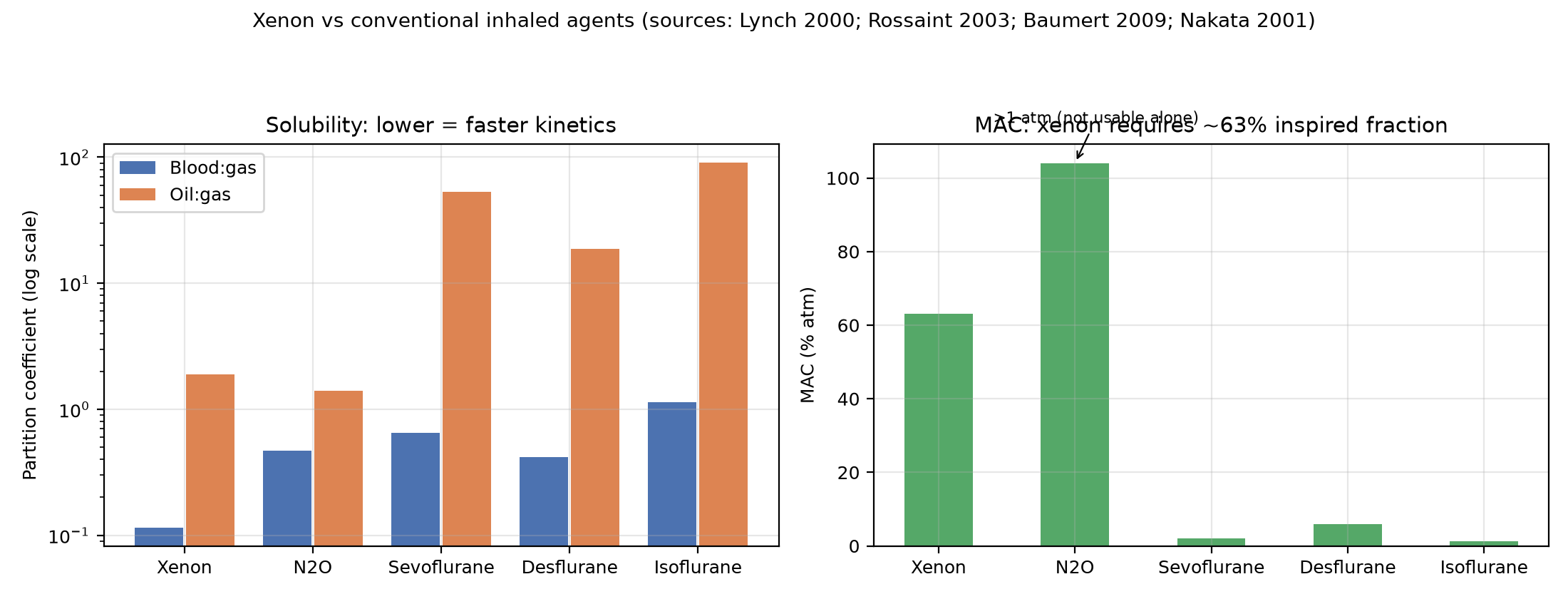
Figure 2. Cost per anesthesia case. Xenon costs 4-7x more than conventional agents across eras; LENOXe-era real-world cases cost EUR 592 manual vs EUR 370 with optimized ECO-mode delivery; worst-case primary-production pricing reaches $1,517. Sources: Nakata 1999; 2003 Anesthesiology editorial; OAS 2013; Med Gas Res 2013; Neice & Zornow 2016 [48,51,53,58].
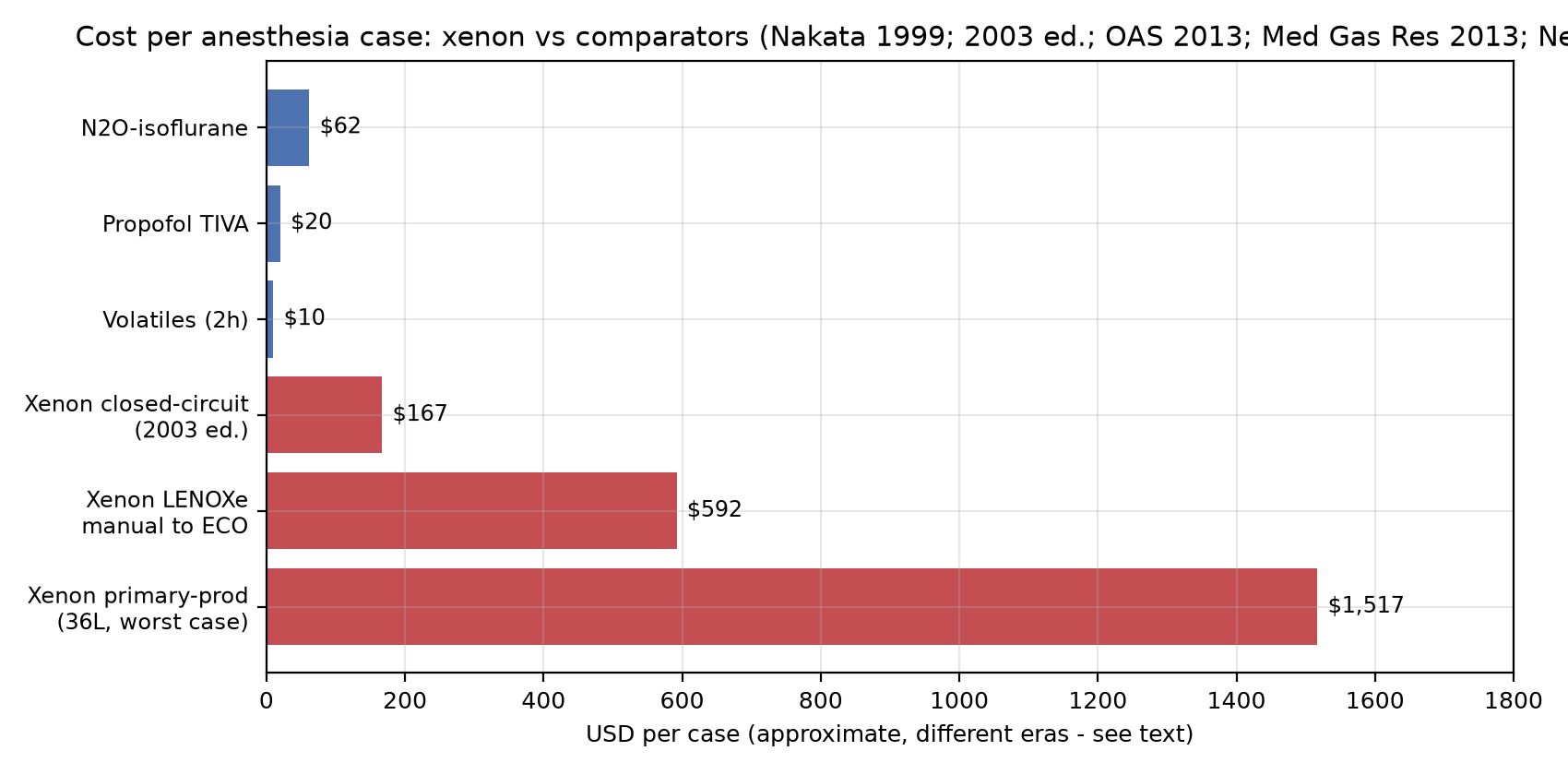
Figure 3. Supply economics. Left: the theoretical world xenon supply ceiling covers only ~0.5% of annual anesthetics at realistic consumption — the “0.5% problem.” Right: documented price history, with the 2022 post-invasion spike. Sources: JRC 2022; SpecGas 2026; Neice & Zornow 2016 [52,53,57,58].
References (Vancouver — PMID-verified 2026-09-16)
- Cullen SC, Gross EG. The anesthetic properties of xenon in animals and human beings, with additional observations on krypton. Science. 1951;113(2942):580-2. PMID 14834873.
- Lawrence JH, Loomis WF, Tobias CA, Turpin FH. Preliminary observations on the narcotic effect of xenon with a review of values for solubilities of gases in water and oils. J Physiol. 1946;105(3):197-204. doi:10.1113/jphysiol.1946.sp004164.
- Cullen SC, Eger EI 2nd, Cullen BF, Gregory P. Observations on the anesthetic effect of the combination of xenon and halothane. Anesthesiology. 1969;31(4):305-9.
- Lachmann B, Armbruster S, Schairer W, et al. Safety and efficacy of xenon in routine use as an inhalational anaesthetic. Lancet. 1990;335(8703):1413-5. PMID 1972207.
- Boomsma F, Rupreht J, Man in ’t Veld AJ, et al. Haemodynamic and neurohumoral effects of xenon anaesthesia — a comparison with nitrous oxide. Anaesthesia. 1990;45(4):273-8. doi:10.1111/j.1365-2044.1990.tb14731.x.
- Lane GA, Nahrwold ML, Tait AR, et al. Anesthetics as teratogens: nitrous oxide is fetotoxic, xenon is not. Science. 1980;210(4472):899-901. PMID 7434002.
- Franks NP, Dickinson R, de Sousa SL, Hall AC, Lieb WR. How does xenon produce anaesthesia? Nature. 1998;396(6709):324. doi:10.1038/24525.
- Dickinson R, Peterson BK, Banks P, et al. Competitive inhibition at the glycine site of the N-methyl-D-aspartate receptor by the anesthetics xenon and isoflurane: evidence from molecular modeling and electrophysiology. Anesthesiology. 2007;107(5):756-67. PMID 18073551.
- Banks P, Franks NP, Dickinson R. Competitive inhibition at the glycine site of the N-methyl-D-aspartate receptor mediates xenon neuroprotection against hypoxia-ischemia. Anesthesiology. 2010;112(3):614-22.
- Gruss M, Bushell TJ, Bright DP, Lieb WR, Mathie A, Franks NP. Two-pore-domain K+ channels are a novel target for the anesthetic gases xenon, nitrous oxide, and cyclopropane. Mol Pharmacol. 2004;65(2):443-52. doi:10.1124/mol.65.2.443.
- Bantel C, Maze M, Trapp S. Neuronal preconditioning by inhalational anesthetics: evidence for the role of plasmalemmal ATP-sensitive potassium channels. Anesthesiology. 2009;110(5):986-95. PMID 19352153.
- Dickinson R, Franks NP. Bench-to-bedside review: molecular pharmacology and clinical use of inert gases in anesthesia and neuroprotection. Crit Care. 2010;14(4):206. PMID 20236449.
- McGuigan S, Marie DJ, O’Bryan LJ, et al. The cellular mechanisms associated with the anesthetic and neuroprotective properties of xenon: a systematic review of the preclinical literature. Front Neurosci. 2023;17:1225191. doi:10.3389/fnins.2023.1225191.
- Suzuki T, et al. Nitrous oxide and xenon inhibit the human (α7)5 nicotinic acetylcholine receptor expressed in Xenopus oocyte. Anesth Analg. 2003;96(2):384-9.
- Nakata Y, Goto T, Ishiguro Y, Terui K, Kawakami H, et al. Minimum alveolar concentration (MAC) of xenon with sevoflurane in humans. Anesthesiology. 2001;94(4):611-4. PMID 11379681.
- Goto T, Nakata Y, Ishiguro Y, et al. Minimum alveolar concentration-awake of xenon alone and in combination with isoflurane or sevoflurane. Anesthesiology. 2000;93(5):1188-93.
- Goto T, Saito H, Nakata Y, et al. Emergence times from xenon anaesthesia are independent of the duration of anaesthesia. Br J Anaesth. 1997;79(5):595-9. PMID 9422897.
- Goto T, Saito H, Shinkai M, et al. Xenon provides faster emergence from anesthesia than does nitrous oxide-sevoflurane or nitrous oxide-isoflurane. Anesthesiology. 1997;86(6):1273-8. PMID 9197295.
- Goto T, et al. The blood-gas partition coefficient of xenon may be lower than generally accepted. Br J Anaesth. 1998;80(2):255-6. PMID 9602599.
- Steward A, Allott PR, Cowles AL, Mapleson WW. Solubility coefficients for inhaled anaesthetics for water, oil and biological media. Br J Anaesth. 1973;45(3):282-93.
- Luttropp HH, Thomasson R, Dahm S, et al. Clinical experience with minimal xenon anaesthesia. Acta Anaesthesiol Scand. 1994;38(2):121-5. PMID 7909641.
- Calzia E, Stahl W, Radermacher P, et al. Continuous arterial PO2 and PCO2 measurements during nitrous oxide and xenon elimination. Anesthesiology. 1999;90(3):829-34. PMID 10078685.
- Coburn M, et al. Randomized controlled trial of the haemodynamic and recovery effects of xenon or propofol anaesthesia. Br J Anaesth. 2005;94(2):198-202. PMID 16225724.
- Coburn M, et al. Emergence and early cognitive function in the elderly after xenon or desflurane anaesthesia: a double-blinded randomized controlled trial. Br J Anaesth. 2007;98(6):756-62. PMID 17485435.
- Rossaint R, Reyle-Hahn M, Schulte am Esch J, et al. Multicenter randomized comparison of the efficacy and safety of xenon and isoflurane in patients undergoing elective surgery. Anesthesiology. 2003;98(1):6-13. PMID 12502972.
- Wappler F, Rossaint R, Baumert J, et al. Multicenter randomized comparison of xenon and isoflurane on left ventricular function in patients undergoing elective surgery. Anesthesiology. 2007;106(3):463-71.
- Hofland J, Ouattara A, Fellahi JL, et al. Effect of xenon anesthesia compared to sevoflurane and total intravenous anesthesia for coronary artery bypass graft surgery on postoperative cardiac troponin release: a randomized, multicenter, 3-arm trial. Anesthesiology. 2017;127(6):918-33. PMID 28872484.
- Ma D, Wilhelm S, Maze M, Franks NP. Neuroprotective and neurotoxic properties of the ‘inert’ gas, xenon. Br J Anaesth. 2002;89(5):739-46. PMID 12393773.
- Homi HM, Yokoo N, Ma D, et al. The neuroprotective effect of xenon administration during transient middle cerebral artery occlusion in mice. Anesthesiology. 2003;99(4):876-81. PMID 14508320.
- David HN, Haelewyn B, Risso JJ, et al. Neuroprotective effects of xenon: a therapeutic window of opportunity in rats subjected to transient cerebral ischemia. FASEB J. 2008;22(1):188-96. PMID 18024836.
- Ma D, Lim T, Xu J, et al. Xenon preconditioning protects against renal ischemic-reperfusion injury via HIF-1α activation. J Am Soc Nephrol. 2009;20(4):713-20. PMID 19144758.
- Fries M, Nolte K, Coburn M, et al. Xenon reduces neurohistopathological damage and improves the early neurological deficit after cardiac arrest in pigs. Crit Care Med. 2008;36(8):2420-6.
- Ma D, Hossain M, Chow A, et al. Xenon and hypothermia combine to provide neuroprotection from neonatal asphyxia. Ann Neurol. 2005;58(2):182-93.
- Hobbs C, Thoresen M, Tucker A, et al. Xenon and hypothermia combine additively, offering long-term functional and histopathologic neuroprotection after neonatal hypoxia/ischemia. Stroke. 2008;39(4):1307-13.
- Petersen-Felix S, Luginbühl M, Schnider TW, et al. Comparison of the analgesic potency of xenon and nitrous oxide in humans evaluated by experimental pain. Br J Anaesth. 1998;81(5):742-7. PMID 10193287.
- Yagi M, Mashimo T, Kawaguchi T, Yoshiya I. Analgesic and hypnotic effects of subanaesthetic concentrations of xenon in human volunteers: comparison with nitrous oxide. Br J Anaesth. 1995;74(6):670-3. PMID 7640122.
- Coburn M, Kunitz O, Apfel CC, et al. Incidence of postoperative nausea and emetic episodes after xenon anaesthesia compared with propofol-based anaesthesia. Br J Anaesth. 2008;100(5):625-30. PMID 18397921.
- Fahlenkamp AV, et al. Nausea and vomiting following balanced xenon anesthesia compared to sevoflurane: a post-hoc explorative analysis of a randomized controlled trial. PLoS One. 2016;11(4):e0153807. PMID 27111335.
- Reinelt H, et al. Diffusion of xenon and nitrous oxide into the bowel. Anesthesiology. 2001;94(3):475-82. PMID 11818790.
- Benavides R, Maze M, Franks NP. Expansion of gas bubbles by nitrous oxide and xenon. Anesthesiology. 2006;104(2):299-305. PMID 16436849.
- Sulbaek Andersen MP, Nielsen OJ, Sherman JD. Assessing the potential climate impact of anaesthetic gases. Lancet Planet Health. 2023;7(7):e622-e629.
- Gadani H, Vyas A. Anesthetic gases and global warming: potentials, prevention and future of anesthesia. Anesth Essays Res. 2011;5(1):5-10. PMID 25885293.
- Goto T. Is there a future for xenon anesthesia? Can J Anaesth. 2002;49(5):447-52.
- Baur CP, et al. Xenon does not induce contracture in human malignant hyperthermia muscle. Br J Anaesth. 2000;85(5):712-6. PMID 11194673.
- Froeba G, Marx T, Pazhur J, et al. Xenon does not trigger malignant hyperthermia in susceptible swine. Anesthesiology. 1999;91(4):1047-52.
- Sanders RD, Franks NP, Maze M. Xenon: no stranger to anaesthesia. Br J Anaesth. 2003;91(5):709-17. PMID 14570795.
- Sanders RD, Ma D, Maze M. Xenon: elemental anaesthesia in clinical practice. Br Med Bull. 2005;71:115-35.
- Baumert J-H. Xenon-based anesthesia: theory and practice. Open Access Surg. 2009;2:5-13.
- Lynch C 3rd, Baum J, Tenbrinck R. Xenon anesthesia. Anesthesiology. 2000;92(3):865-8.
- Bajaj T, Cascella M, Borger J. Xenon. StatPearls. Treasure Island (FL): StatPearls Publishing; 2022. https://ncbi.nlm.nih.gov/books/NBK540997/.
- Stoppe C, Coburn M, Rossaint R, et al. Xenon consumption during general surgery: a retrospective observational study. Med Gas Res. 2013;3:12.
- European Commission Joint Research Centre. Rare Gases (Krypton, Neon, Xenon): Impact assessment for supply security. 2022. https://rmis.jrc.ec.europa.eu/uploads/JRC130349_01_rare_gases.pdf.
- Neice AE, Zornow MH. Xenon anaesthesia for all, or only a select few? Anaesthesia. 2016;71(11):1267-72.
- Cerasoli I, et al. Xenon anesthesia in veterinary medicine: a review. Front Vet Sci. 2017;4:162. doi:10.3389/fvets.2017.00162. PMID 29034250.
- Rawat S, Dingley J. Closed-circuit xenon delivery using a standard anesthesia workstation. Anesth Analg. 2010;110(1):101-9. PMID 19825059.
- Dingley J, Mason R. A cryogenic machine for selective recovery of xenon from breathing system waste gases. Anesth Analg. 2007;105(5):1312-8. PMID 17959960.
- McGuigan S, Abrahams BF, Scott DA. A narrative review of gas separation and conservation technologies during xenon anesthesia. Med Gas Res. 2025;15(1):93-100. PMID 39436172.
- Law LS, et al. Xenon anesthesia: a systematic review and meta-analysis of randomized controlled trials. Anesth Analg. 2016;122(3):678-97. PMID 26273750.
- Laitio R, Hynninen M, Arola O, et al. Effect of inhaled xenon on cerebral white matter damage in comatose survivors of out-of-hospital cardiac arrest: a randomized clinical trial. JAMA. 2016;315(11):1120-8. PMID 26978207.
- XePOHCAS investigators. Inhaled xenon for neuroprotection after cardiac arrest: XePOHCAS. ClinicalTrials.gov NCT03176186; EudraCT 2017-002514-32.
- Azzopardi D, Robertson NJ, Bainbridge A, et al. Xenon and hypothermia for hypoxic-ischaemic encephalopathy: the TOBY-Xe randomised trial. Lancet Neurol. 2016;15(2):145-53.
- CoolXenon2/3 trial group. Cooling with or without inhaled xenon for neonatal hypoxic-ischaemic encephalopathy: combined results. HRA research summary; NCT02071394; NCT01545271.
- Cochrane. Cooling plus inhaled xenon for newborns with hypoxic-ischaemic encephalopathy. Cochrane Database Syst Rev. CD012753.
- Polarean Imaging plc. XENOVIEW (xenon Xe 129 hyperpolarized) FDA label. NDA 214375. 2022.
- CMS. HCPCS C9791 — MRI with inhaled hyperpolarized xenon-129 contrast. 2023.
- Grist JT, et al. Hyperpolarized 129Xe MRI abnormalities in dyspneic patients 3 months after COVID-19 pneumonia. Radiology. 2021;300(3):E327-E337. doi:10.1148/radiol.2021210033.
- Elsaidi SK, et al. Xenon recovery at room temperature using metal-organic frameworks. Chem Eur J. 2017;23:10758-62. doi:10.1002/chem.201702668.
- White SM, et al. Principles of environmentally-sustainable anaesthesia: a global consensus statement by the World Federation of Societies of Anaesthesiologists. Anaesthesia. 2022;77(7). doi:10.1111/anae.15598.
- European Society of Anaesthesiology and Intensive Care. Glasgow Declaration on Sustainability in Anaesthesiology and Intensive Care. 2023.
- Invero Pharma LLC. Corporate and clinical development materials (XENEX; XePOHCAS; TBI IND submitted Nov 25, 2025). https://inveropharma.com.
- Air Liquide. LENOXe launch press releases (2007); AIFA revocation, Gazzetta Ufficiale n.197/2020.
- Negovsky Institute. Neuroprotective effects of xenon treatment in patients with cerebral infarction. ClinicalTrials.gov NCT05335109.
- Polarean Imaging plc. FY2024 trading update; 2025 commercial announcements (NIH, UVA, Taiwan). 2025.
- Jevtović-Todorović V, Todorović SM, Mennerick S, Powell S, Dikranian K, et al. Nitrous oxide (laughing gas) is an NMDA antagonist, neuroprotectant and neurotoxin. Nat Med. 1998;4(4):460-3. PMID 9546794.
- Suzuki T, Koyama H, Sugimoto M, Uchida I, Mashimo T. The diverse actions of volatile and gaseous anesthetics on human-cloned 5-hydroxytryptamine3 receptors expressed in Xenopus oocytes. Anesthesiology. 2002;96(3):699-704. PMID 11873047.
- Yamakura T, Harris RA. Effects of gaseous anesthetics nitrous oxide and xenon on ligand-gated ion channels: comparison with isoflurane and ethanol. Anesthesiology. 2000;93(4):1095-101. PMID 11020766.
Review complete as of the preparation date. Research-agent briefs, PMID verification details, and source materials are preserved in the project directory and the provenance sidecar.