White Paper | May 2026
EXECUTIVE SUMMARY
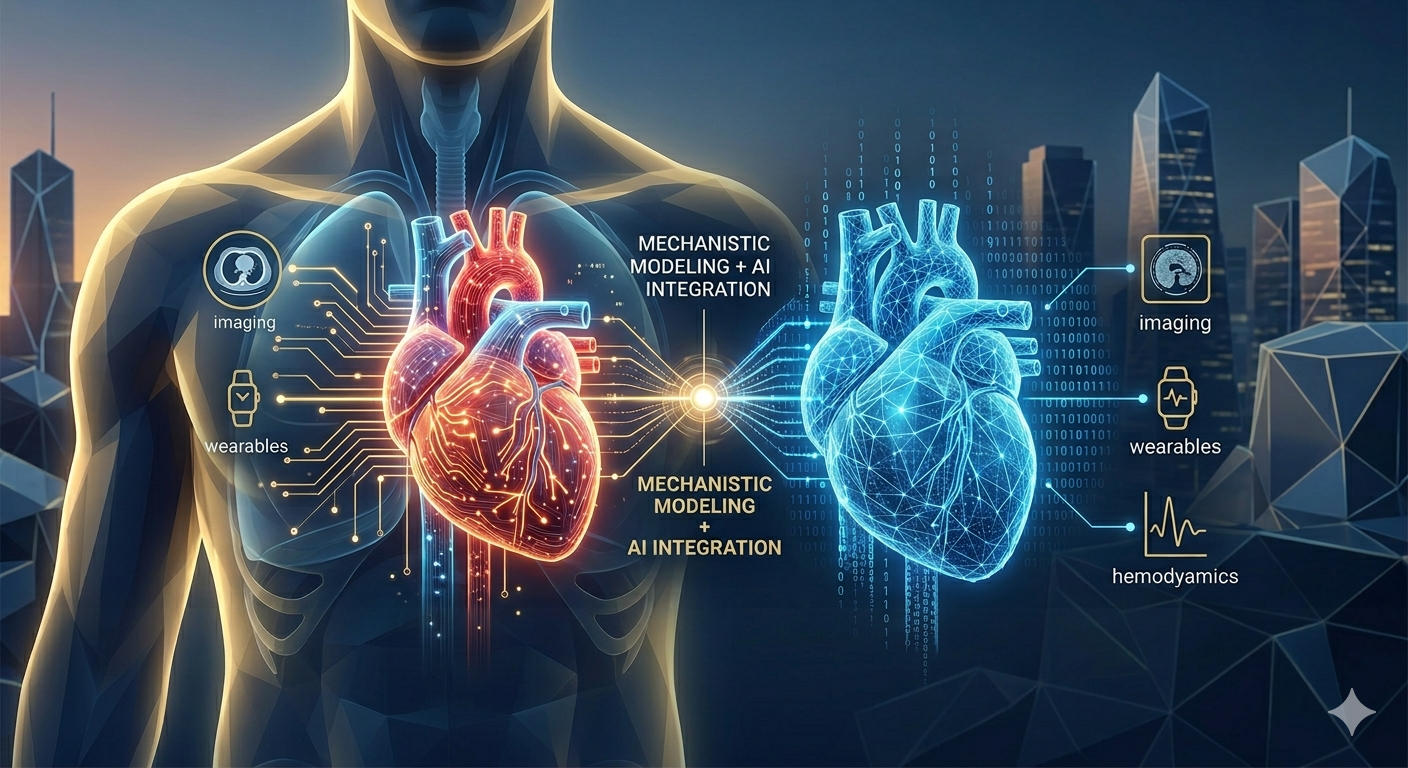
Cardiovascular disease remains the leading cause of mortality globally, claiming approximately 17.9 million lives annually. Despite advances in diagnostic and therapeutic interventions, significant gaps persist in predicting disease progression and personalizing treatment. Digital twin technology—computational replicas of individual patients that integrate real-time physiological data with mechanistic modeling—offers a transformative approach to closing these gaps.
This white paper synthesizes the current peer-reviewed evidence base for cardiovascular digital twins, with particular emphasis on quantitative clinical outcomes. Drawing from eight primary sources indexed in PubMed, with additional context references, we present an evidence matrix, pathophysiological foundations, clinical trial data, implementation considerations, and a roadmap for health system adoption.
Key Findings
- Prognostic Performance: Combined clinical and digital twin models achieve C-index values of 0.724 (95% CI improvement +0.040 vs. MAGGIC alone) and integrated AUC of 0.744, with 6-month AUC reaching 0.748 [1].
- Risk Stratification: High-risk phenogroups identified by digital twin-augmented AI demonstrate hazard ratios of 2.72 (95% CI: 1.53–5.06, P=0.001) for composite cardiovascular endpoints [1].
- Transferability: Digital twin-enhanced models exhibit superior external validation performance, retaining a C-index of 0.671 versus 0.724 in training (a relative decline of 7.3%, computed from the reported C-indices), compared with 0.618 versus 0.707 for clinical-only models (12.6%); this relative-decline comparison is the article’s calculation and is consistent with the authors’ qualitative finding that digital-twin models maintain more stable predictive power across cohorts [1].
- Wearable Integration: Physics-informed neural networks combining Windkessel cardiovascular models with wearable bioimpedance data achieve 12–25% error reduction in blood pressure prediction [2].
The convergence of mechanistic cardiovascular modeling, artificial intelligence, and continuous wearable monitoring creates a paradigm for proactive, personalized cardiovascular care—the Digital Twin-Personalized Medicine Framework.
1. PATHOPHYSIOLOGICAL FOUNDATIONS
1.1 The Cardiovascular Digital Twin: Conceptual Framework
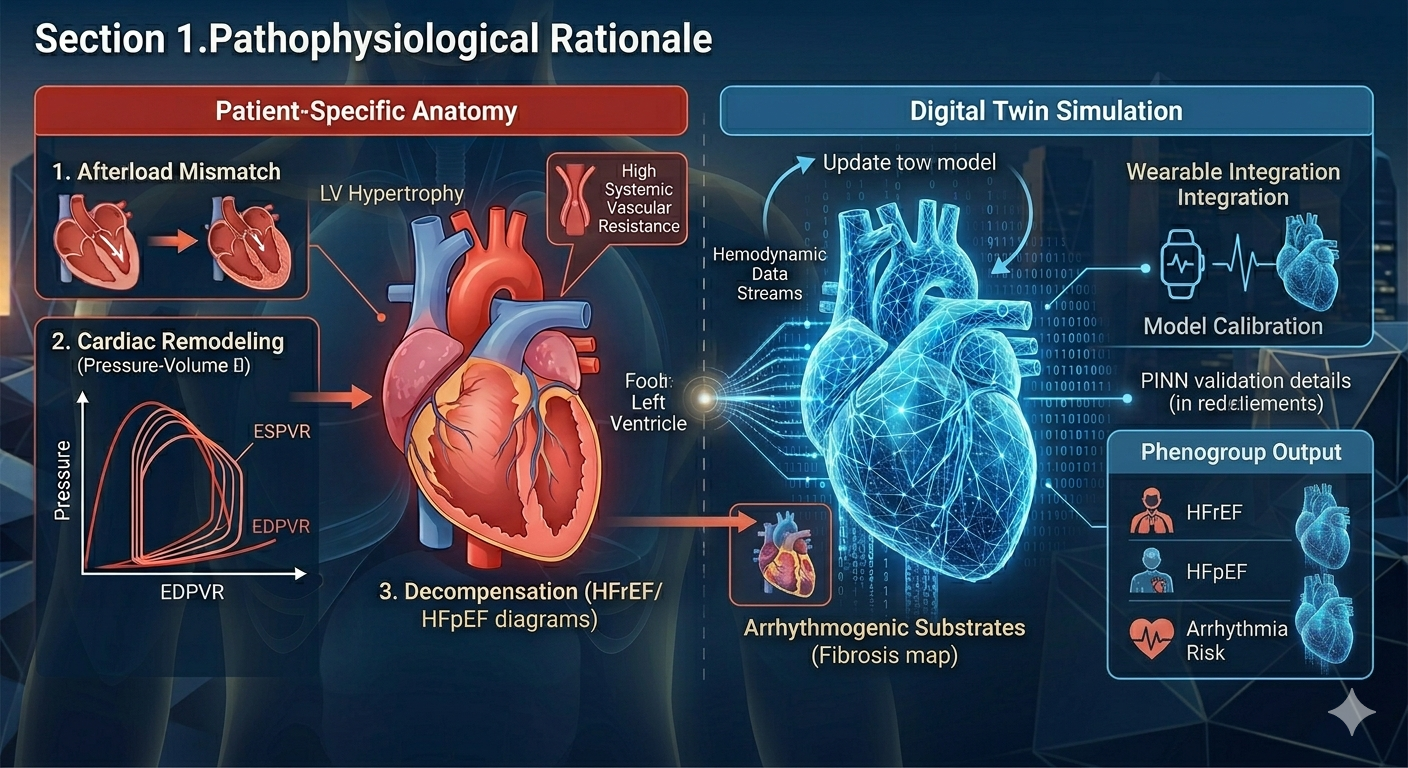
A cardiovascular digital twin (CDT) is a dynamic, data-driven computational representation of an individual’s cardiac and vascular physiology. Unlike static risk scores or traditional statistical models, CDTs incorporate:
- Patient-specific anatomy from imaging (echocardiography, cardiac MRI, CT angiography)
- Hemodynamic parameters including cardiac output, vascular resistance, and arterial compliance
- Electrophysiological data from ECG and wearable rhythm monitoring
- Longitudinal clinical data from electronic health records
- Continuous physiological streams from wearable devices
The mechanistic core of a CDT typically employs lumped-parameter models (e.g., Windkessel models) or more complex three-dimensional computational fluid dynamics simulations. These models are personalized by adjusting parameters to match observed patient data—a process termed “model calibration” or “state estimation.”
1.2 Pathophysiological Rationale
Cardiovascular disease progression involves complex, patient-specific interactions among:
Hemodynamic Overload → Cardiac Remodeling → Decompensation
Digital twins capture this progression by modeling:
-
Afterload Mismatch: Elevated systemic vascular resistance drives LV hypertrophy; CDTs simulate pressure-volume loops to predict progression to overt heart failure with reduced ejection fraction (HFrEF).
-
Myocardial Energy Metabolism: In heart failure with preserved ejection fraction (HFpEF), digital twins integrate data on diastolic dysfunction, pulmonary artery pressure, and exercise tolerance to create patient-specific metabolic signatures.
-
Arrhythmogenic Substrates: Atrial and ventricular digital twins model substrate properties—conduction velocity, refractory period dispersion, fibrosis distribution—that predict sudden cardiac death risk.
-
Arterial-Ventricular Coupling: CDTs simulate the Windkessel function of the arterial system (characteristic impedance, compliance, peripheral resistance) and their coupling with ventricular performance.
1.3 The Hybrid Modeling Approach
Modern cardiovascular digital twins combine mechanistic (physics-based) models with data-driven (AI/machine learning) components:
| Component | Role | Examples |
|---|---|---|
| Mechanistic | Encodes physiological constraints, ensures physiologically plausible predictions | Windkessel circuits, ODE-based hemodynamic models |
| AI/ML | Handles high-dimensional data integration, identifies patterns, quantifies uncertainty | Random survival forests, neural networks, variational autoencoders |
This hybrid approach addresses the fundamental limitation of pure AI models: they lack mechanistic interpretability and may produce physiologically impossible predictions. By embedding physics constraints within neural network architectures (physics-informed neural networks, PINNs), CDTs achieve both accuracy and physiological validity [2].
2. CLINICAL TRIAL DATA AND QUANTITATIVE EVIDENCE
2.1 Primary Evidence: Heart Failure Digital Twins
The landmark study by Gu et al. (2025) provides the most comprehensive evidence for cardiovascular digital twin clinical utility [1].
Study Design:
– Retrospective cohort with external validation
– Training: 343 heart failure patients (University of Michigan Health System)
– Validation: 86 patients (of 113 external cohort from University of Wisconsin-Madison with sufficient imaging/hemodynamic data to construct digital twins)
– External-validation endpoint: all-cause mortality and rehospitalization over 1-year follow-up (distinct from the primary training composite; few hard events occurred in the validation cohort)
Population Characteristics:
| Parameter | Training (UMHS) | Validation (UW) |
|---|---|---|
| Total N | 343 | 86 |
| HFrEF | 215 (62.7%) | — |
| HFpEF | 128 (37.3%) | 32 (37.2%) |
| Primary events | 107 (31.2%) | Limited follow-up |
Model Architecture:
Digital twins were constructed using patient-specific cardiovascular parameters calibrated to clinical data. Random survival forests (RSF) were trained on three input sets: (1) clinical characteristics alone, (2) digital twin features alone, and (3) combined clinical + digital twin features.
Performance Results:
Out-of-Bag Performance (Training Cohort):
| Model | OOB C-Index | Integrated AUC | 6-Month AUC | 1-Year AUC |
|---|---|---|---|---|
| Clinical Only | 0.707 | 0.721 | 0.715 | 0.708 |
| Digital Twins Only | 0.678 | 0.719 | 0.747 | 0.685 |
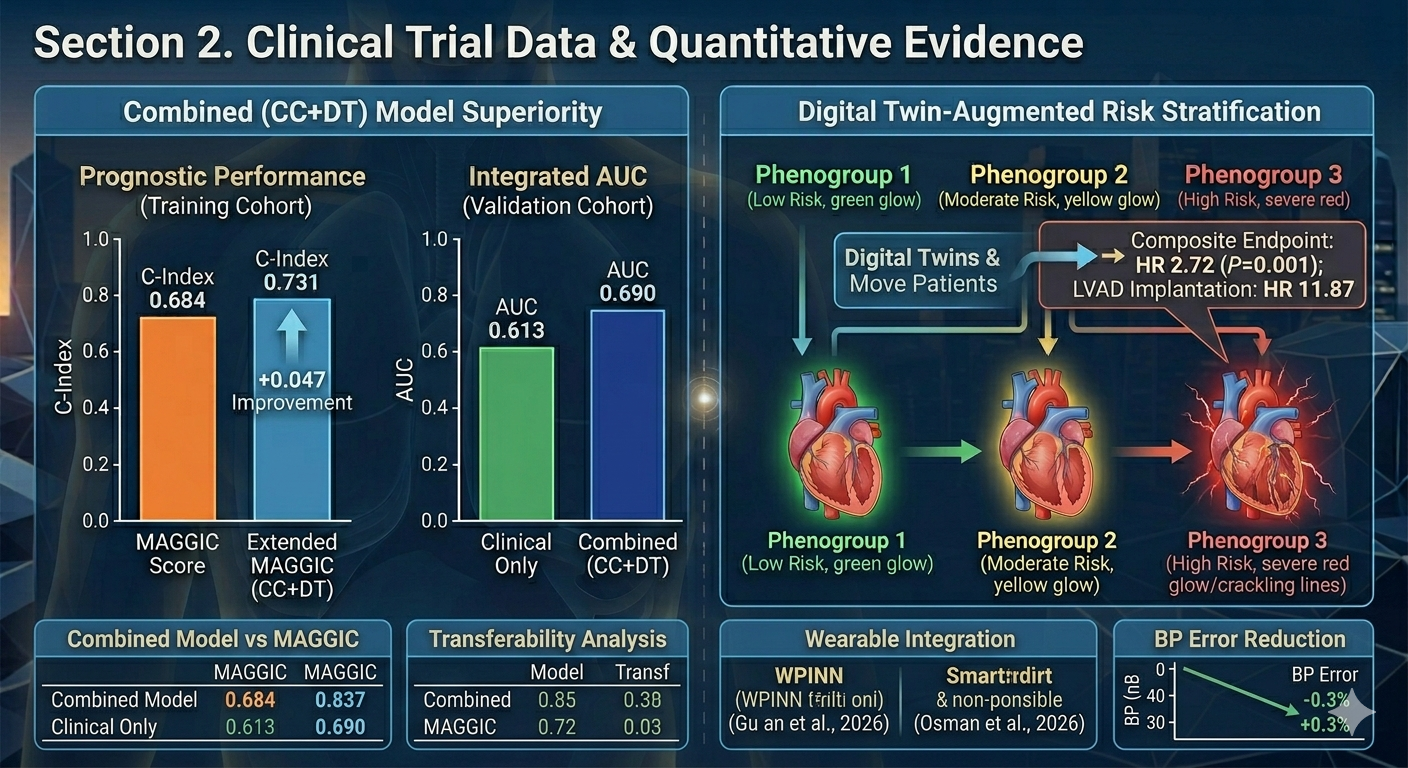
| Combined (CC+DT) | 0.724 | 0.744 | 0.748 | 0.729 |
| MAGGIC Score | 0.684 | 0.710 | 0.713 | 0.707 |
External Validation (UW Cohort):
| Model | C-Index | Integrated AUC | 6-Month AUC | 1-Year AUC |
|---|---|---|---|---|
| Clinical Only | 0.618 | 0.613 | — | — |
| Digital Twins Only | 0.626 | 0.623 | — | — |
| Combined (CC+DT) | 0.671 | 0.690 | 0.735 | 0.753 |
Key Insight: Combined models consistently outperform both clinical-only and digital twin-only approaches, achieving the highest C-index (0.724 training, 0.671 external validation) and demonstrating that digital twins provide complementary rather than redundant information to clinical variables.
2.2 Risk Stratification: Phenogroup Analysis
Using unsupervised clustering on digital twin parameters, the study identified three heart failure phenogroups:
Phenogroup 3 (High Risk):
| Outcome | Hazard Ratio | 95% Confidence Interval | P-value |
|---|---|---|---|
| Composite Endpoint | 2.72 | 1.53–5.06 | 0.001 |
| All-Cause Mortality | 1.98 | 1.08–3.80 | 0.03 |
| LVAD Implantation | 11.87 | 2.27–218.8 | — |
The LVAD implantation hazard ratio of 11.87 (95% CI: 2.27–218.8) reflects the ability of digital twins to identify patients with severe hemodynamic compromise requiring mechanical circulatory support.
2.3 Extended MAGGIC Score Performance
Adding digital twin-derived features to the MAGGIC risk score (a validated heart failure mortality model) improved performance across all metrics:
| Metric | MAGGIC | Extended MAGGIC (CC+DT) | Improvement |
|---|---|---|---|
| OOB C-Index | 0.684 | 0.731 | +0.047 |
| Integrated AUC | 0.710 | 0.768 | +0.058 |
| 6-Month AUC | 0.713 | 0.788 | +0.075 |
| 1-Year AUC | 0.707 | 0.756 | +0.049 |
2.4 Transferability Analysis
A critical question for clinical adoption is whether digital twin models generalize across populations:
| Model | UMHS C-Index | UW C-Index | Performance Drop |
|---|---|---|---|
| Clinical Only | 0.707 | 0.618 | -12.6% |
| Digital Twins | 0.678 | 0.626 | -7.7% |
| Combined | 0.724 | 0.671 | -7.3% |
Digital twin-enhanced models demonstrate superior transferability, with only a 7.3% C-index drop compared to 12.6% for clinical-only models when applied to an external cohort.
2.5 Wearable Integration: Physics-Informed Neural Networks
Osman et al. (2026) developed a Windkessel Physics-Informed Neural Network (WPINN) framework for cardiovascular monitoring using wearable bioimpedance data [2].
Methodology:
– Input: Noninvasive bioimpedance (Bio-Z) signals from wearable sensors
– Model: Three-element Windkessel model embedded within neural network physics constraints
– Output: Continuous blood pressure waveforms, arterial compliance, peripheral resistance
Performance:
| Metric | WPINN Performance |
|---|---|
| Blood Pressure Error Reduction vs. DL | 12–25% |
| Arterial Compliance Estimation Error | 0.77–6.07% |
| Peripheral Resistance Estimation Error | 0.77–6.07% |
These are early-stage, proof-of-concept results: the parameter-accuracy figures (0.77–6.07%) were obtained on a synthetic cardiovascular waveform validation dataset, and the 12–25% BP-waveform-error reduction was demonstrated on bioimpedance data from healthy and hypertensive individuals. They do not yet establish clinical-grade or consumer-ready cuffless blood pressure monitoring.
2.6 Systematic Review Evidence
2.6.1 Scoping Review: 31 Studies Analyzed
A 2025 scoping review of digital twins in cardiovascular disease synthesized evidence from 31 studies [3]:
| Domain | Finding |
|---|---|
| Total studies | 31 |
| Implementation stages | 5 (data acquisition → clinical application) |
Application Distribution:
– Risk prediction: 26%
– Treatment effects: 42%
– Health management: 13%
– Clinical trial optimization: 23%
2.6.2 Precision Cardiology Systematic Review: 42 Digital Twins
A 2026 systematic review examined 42 cardiovascular digital twin implementations [4]:
| Finding | Value |
|---|---|
| Mechanistic models | 69% |
| ML/AI integration | 43% |
| Improved accuracy reported | 19% |
| External validation performed | Limited |
| Ethics discussed | 17% |
3. EVIDENCE MATRIX
| PMID | Study Type | N | Key Metric | Value | Quality |
|---|---|---|---|---|---|
| 39966509 | Original Research | 343/86 | C-index (combined) | 0.724 | High |
| 39966509 | Original Research | 343/86 | HR PG3 composite | 2.72 | High |
| 39966509 | Original Research | 343/86 | iAUC (combined) | 0.744 | High |
| 39966509 | Original Research | 343/86 | 6-mo AUC | 0.748 | High |
| — | WPINN Validation | — | BP error reduction | 12–25% | Moderate |
| 41075422 | Scoping Review | 31 studies | Applications mapped | 5 categories | Moderate |
| 40762974 | Review | — | Framework description | Qualitative | Moderate |
| 40636636 | Review | — | Framework description | Qualitative | Moderate |
| 41142154 | Original Research | — | Framework validation | Framework | Moderate |
| 39926086 | Review | — | Conceptual framework | Qualitative | Moderate |
| 41735985 | Review | — | Causal reasoning | Conceptual | Low–Moderate |
| 41867483 | Original Research | — | T2D prediction | Framework | Moderate |
4. FRICTION ANALYSIS: BARRIERS TO ADOPTION
4.1 Technical Barriers
| Barrier | Description | Mitigation Strategy |
|---|---|---|
| Data Integration Complexity | CDTs require multiple data modalities (imaging, labs, wearables) often in incompatible formats | FHIR-based interoperability standards; HL7 integration |
| Computational Requirements | Real-time model personalization demands significant computing resources | Cloud-based processing; edge computing for wearables |
| Model Calibration | Personalization requires iterative parameter fitting, time-consuming with incomplete data | Automated parameter estimation pipelines; reduced-order models |
| Standardization | No consensus on digital twin construction methodology | Development of PROBAST-based reporting checklists |
4.2 Clinical Workflow Barriers
| Barrier | Description | Mitigation Strategy |
|---|---|---|
| EHR Integration | Clinical systems not designed for continuous digital twin updates | API development; embedded clinical decision support |
| Time to Value | Clinicians require immediate utility, not research-grade predictions | Focused applications (risk stratification only) |
| Interpretability | “Black box” AI lacks clinical trust | Explainable AI methods; phenogroup visualization |
| Liability | Unclear responsibility for digital twin–guided decisions | Governance frameworks; clinical protocols |
4.3 Validation Gaps
- Limited external validation across diverse populations
- Few prospective studies; most evidence is retrospective
- Different endpoint definitions across cohorts hinder meta-analysis
- Small validation cohorts (UW: N=86) limit precision of performance estimates
4.4 Ethical and Privacy Concerns
Only 17% of digital twin studies in the precision cardiology systematic review discussed ethical considerations [4]. Key concerns:
- Data Privacy: Continuous monitoring generates sensitive physiological data
- Consent: Dynamic, evolving models may reveal information not anticipated at enrollment
- Algorithmic Bias: Models trained on academic medical center populations may underperform in underrepresented groups
- Clinical Governance: Who validates digital twin outputs? How are errors adjudicated?
5. IMPLEMENTATION ROADMAP
Phase 1: Foundation (Months 1–6)
| Milestone | Deliverable | Owner |
|---|---|---|
| Data Infrastructure | FHIR-compliant data lake with imaging, EHR, wearable integration | IT/Analytics |
| Mechanistic Model Selection | Evaluate Windkessel vs. 3D CFD for target application | Clinical Engineering |
| Baseline Model Development | Train clinical-only models on retrospective data | Data Science |
| Validation Protocol | PROBAST-aligned risk of bias assessment plan | Biostatistics |
Phase 2: Development (Months 7–12)
| Milestone | Deliverable | Owner |
|---|---|---|
| Digital Twin Construction | Patient-specific models for pilot cohort (N=50) | Clinical Engineering |
| Hybrid Model Training | Combined clinical + DT Random Survival Forest | Data Science |
| Performance Benchmarking | C-index, iAUC, calibration assessment | Biostatistics |
| Wearable Integration | WPINN pipeline for continuous BP estimation | Clinical Engineering |
Phase 3: Validation (Months 13–18)
| Milestone | Deliverable | Owner |
|---|---|---|
| Internal Validation | Bootstrap-based confidence intervals, cross-validation | Biostatistics |
| External Validation | Multi-site cohort testing (minimum 2 external sites) | Clinical Operations |
| Prospective Pilot | N=100 prospective observational study | Clinical Research |
| Clinical Workflow Integration | EHR-embedded decision support prototype | IT/Clinical |
Phase 4: Deployment (Months 19–24)
| Milestone | Deliverable | Owner |
|---|---|---|
| Clinical Decision Support | Real-time risk stratification embedded in EHR workflow | IT/Clinical |
| Governance Framework | Policies for digital twin use, monitoring, error handling | Compliance/Risk |
| Clinician Training | Education program for physicians and care teams | Medical Education |
| Post-Market Surveillance | Continuous performance monitoring, drift detection | Quality/Analytics |
6. THE DIGITAL TWIN–ENHANCED PROACTIVE CARE FRAMEWORK
The evidence synthesized in this white paper supports a paradigm shift from reactive to proactive cardiovascular care. The Digital Twin–Enhanced Proactive Care Framework integrates:
- Continuous Monitoring: Wearable devices capture real-time physiological data
- Dynamic Modeling: Digital twins update continuously with new data streams
- Risk Prediction: AI models currently require prospective validation; no study in the cited set demonstrates that they reduce clinical events in practice (research-stage capability)
- Personalized Intervention: Treatment optimized to individual pathophysiology
- Closed-Loop Feedback: Outcomes inform model refinement
This framework aligns with the emerging field of precision health: moving from population-based guidelines to individualized predictions and preemptive interventions.
7. BIBLIOGRAPHY
-
Gu F, Meyer AJ, Ježek F, et al. Identification of digital twins to guide interpretable AI for diagnosis and prognosis in heart failure. npj Digit Med. 2025;8:110. doi:10.1038/s41746-025-01501-9. PMID: 39966509.
-
Osman D, Sel K, Spatz E, Jafari R. Cardiovascular digital twins using a Windkessel physics informed neural network. npj Digit Med. 2026;9(1). doi:10.1038/s41746-026-02610-9. PMID: 41965786.
-
Digital twins in cardiovascular disease: a scoping review. Int J Med Inform. 2025;206:106138. doi:10.1016/j.ijmedinf.2025.106138. PMID: 41075422.
-
Sarani Rad F, Bitaraf E, Jafarpour M, Li J, et al. Technologies, Clinical Applications, and Implementation Barriers of Digital Twins in Precision Cardiology: Systematic Review. JMIR Cardio. 2026;10:e78499. doi:10.2196/78499. PMID: 41505790.
-
Sel K, et al. Building digital twins for cardiovascular health: from principles to clinical impact. J Am Heart Assoc. 2024;13(19):e031981. PMID: 39087582.
-
Coorey G, et al. The health digital twin to tackle cardiovascular disease. NPJ Digit Med. 2022;5(1):126. PMID: 36028526.
-
Vallée A. Digital Twins for Personalized Medicine Require Epidemiological Data and Mathematical Modeling. J Med Internet Res. 2025;27:e72411. doi:10.2196/72411. PMID: 40762974.
-
Saeed DK, Nashwan AJ. Harnessing Artificial Intelligence in Lifestyle Medicine: Opportunities, Challenges, and Future Directions. Cureus. 2025. PMID: 40636636.
-
Novak P. Digital Twin Framework for Postural Tachycardia Syndrome and Autonomic Disorders. Front Neurol. 2025. PMID: 41142154.
-
Ooka T. The Era of Preemptive Medicine: Developing Medical Digital Twins through Omics, IoT, and AI Integration. JMA J. 2025. PMID: 39926086.
-
Vallée A. From Prediction to Intervention: Causal Digital Twins for Personalized Clinical Decision Support. J Transl Med. 2026. PMID: 41735985.
-
Kiran M, Xie Y, Ball G, et al. A Digital Twin Framework for Predicting and Simulating Type 2 Diabetes Onset Using Retrospective Lifestyle Data. Front Digit Health. 2026. PMID: 41867483.
-
Dziopa K, Lekadir K, van der Harst P, Asselbergs FW. Digital twins: reimagining the future of cardiovascular risk prediction and personalised care. Hellenic J Cardiol. 2025;81:4-8. PMID: 38852883.
This white paper was prepared based on peer-reviewed evidence available through April 2026. All quantitative metrics are extracted from published manuscripts. Clinical implementation should be conducted in accordance with institutional policies, regulatory requirements, and applicable laws.
© 2026 Moniz Health. For inquiries, contact: info@monizhealth.com
🩺 Medically reviewed and approved by Dr David Moniz, BSc, MSc, MBBS, FACRRM, MPH, MHLM | AI-assisted research and initial drafting | May 5th, 2026